
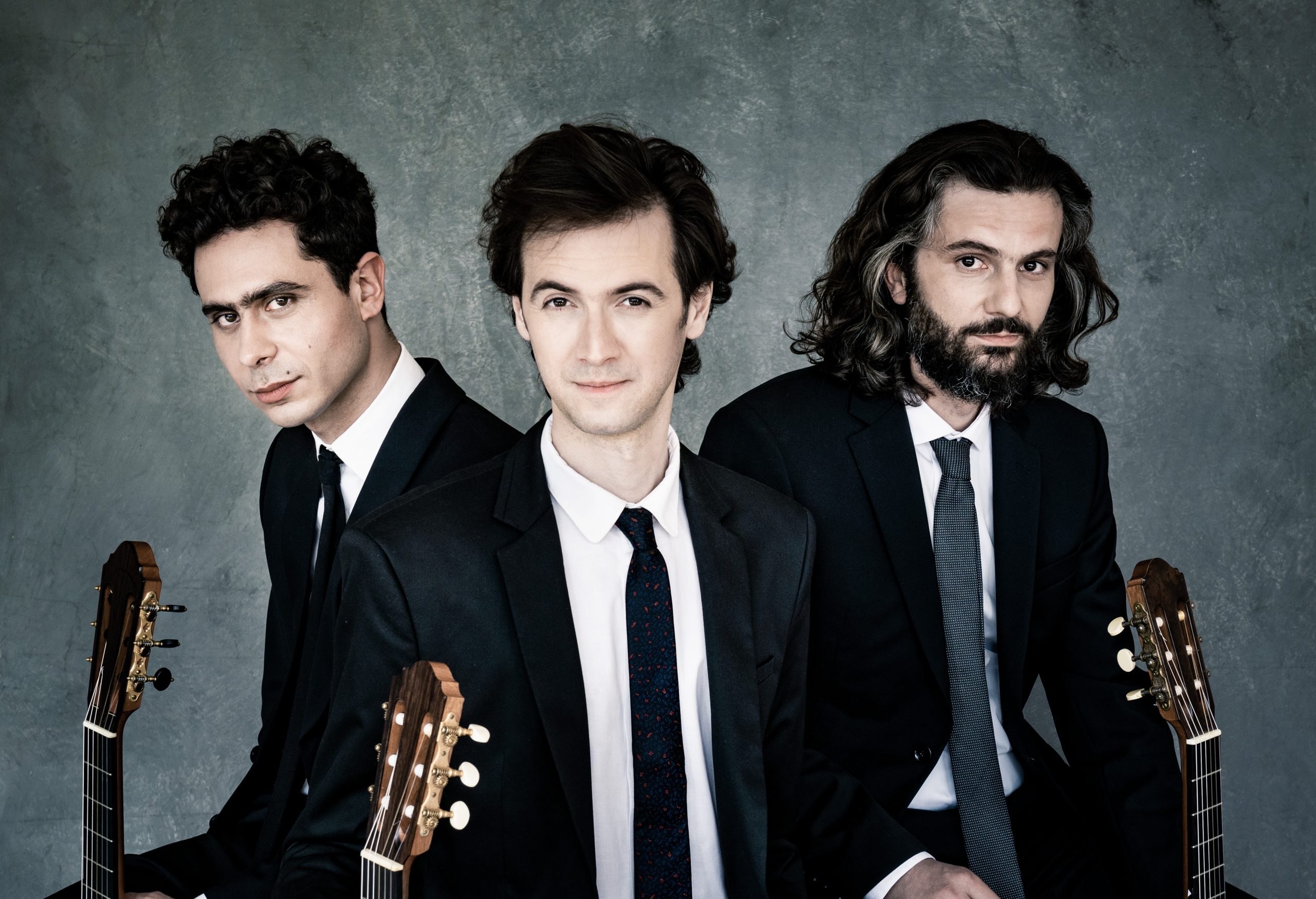

Petrit ceku - guitar
Pedro Ribeiro Rodrigues - guitar
Tomislav Vukšić - guitar
The presence of minor keys in the works of Wolfgang Amadeus Mozart (1756 – 1791) is very rare, and therefore compositions written in them often have a special meaning in his work. Among them are some of the most dramatic and tragic, such as the Requiem in D minor, Symphony no. 40 in G minor, Fantasia for piano in D minor, and a number of others that often reveal some difficult moments of Mozart's life. His Sonata in A minor, no. 8 K. 310 was created at the beginning of the summer of 1778. Mozart was in Paris, and his mother was on the way with him, who fell ill at the time and died at the beginning of July. In this piano sonata (one of only two written in the minor key), the young twenty-two-year-old composer brings unusual drama, anxiety and tragedy, which is directly connected to the death of his mother. The first movement , Allegro maestoso, already brings a theme charged with the unrest of a dotted rhythm and intense chord accompaniment, and the next theme, although in a major, continues with a tireless sixteenth-note shift that finds no peace. Dissonances and tension grow in the development section, while the second movement, Andante cantabile con espressione , brings a respite in a comforting F major. However, the final movement, again in A minor, tirelessly leads to a sad ending, in a galloping Presto in two-quarter time, again filled with unexpected chromatic colors. There is a brief, almost reluctant excursion into a major, but the return to a minor is more forceful, leading to a resolutely tragic ending.
Šimun Čarli Botica (1997) is one of the most promising composers of the younger generation, with a recognizable opus often defined by extra-musical ideas, which leaves the listener free to associate and creates a universal sound space. He describes the composition Les mirages , dedicated to the Trio Elogio and presented this summer at the 51st Osor Music Evenings, as a "vast canvas of sensations and visions", inspired by "a state of exhaustion, the desert heat and under the light of a dazzling night sky". The four linked movements are designed in an “organic form” and lead from the fragmented musical “brushstrokes” in the first movement, Des coups de pinceau dans le ciel de minuit ( Brushstrokes in the Midnight Sky ), through the intense Vertiges des abîmes ( Vertigo of the Abyss ) to the central Ombres et Visions ( Shadows and Visions ), “a state of floating and almost frozen flow of time, where the music reaches stillness, within which “phantoms” appear – distorted reflections of reality created by the application of extended guitar technique”. The music thereby leaves the ambit of the tempered system and “a new sound spectrum is born, rich in unusual frequency relationships, colors and textures”, while the fourth motif connects the whole and is fully revealed in the final movement Clarté ( Clarity ), which “leads to resolution: the end of the visions, the end of the night and the arrival of dawn, both in a musical and existential sense.”
Spanish folk traditions, rhythms and melodies are at the heart of the music of Enrique Granados (1867-1916), a great lyricist of Spanish music, who dedicated most of his work to the piano. In them, he chose in particular the rhythms of Andalusia and his native Catalonia. The Twelve Spanish Dances are one of the highlights of his work. Originally written for piano, they were probably composed in the period 1888-1890 during his stay in Paris. The composer himself first performed them in 1890 in Barcelona. The dances are simple, very clearly structured and reflect some of the main features of melody, rhythm, rhythm and ornamentation that appeared in Spanish folk music, imitating the sound of folk instruments. They are dressed in fine salon attire and the soft, agile style of the piano, which was often transferred to arrangements for other instruments, especially the guitar. Each dance is like a small picture, sometimes elegant, sometimes rustic, carrying contrasting moods. The Galante in G major begins the sequence, bringing an echo of an antique minuet, with ornaments and delicate trills. The Orientale in C minor brings a touch of the exotic, and the chromatic-filled melody over a drone bass evokes Spain's Moorish past. The Fandango conveys the energy of one of the most important Spanish couple dances, with syncopated rhythms accompanied by castanets. The Villanesca is a country dance of rustic charm, simple, catchy melodies and drone accompaniment.
The appearance of an instrumentalist who is also a composer is common in the history of music, and Goran Listeš (1961–2020), a top guitarist who began composing for the guitar during his studies in Zagreb and Graz, could not resist the call to compose. As a performer, he has won numerous awards, performed as a soloist and in chamber ensembles, among which the Zagreb Guitar Trio stands out, and has also worked as a professor at the Academy of Arts of the University of Split. He has left behind an extensive opus for solo guitar and chamber ensembles, including Paradise Island , a composition released in 2004 on the Zagreb Guitar Trio's album of the same name, which evokes a distant, almost escapist land with playful Caribbean-like rhythms, bravura passages, and gentle melodic interludes. Island of Sorrow ( L'isola malinconica ) opens with gentle flageolets and a gentle cantilena, which develops into an increasingly complex interweaving of three guitars, resembling improvisation, and finally returns to the mysterious initial melody, interspersed with flashes of bright harmonies and once again melted in the flageolets.
- Zrinka Matic
Trio Elogio was founded in 2009 by three musicians who studied under Prof. Darko Petrinjak at the Zagreb Academy of Music: Petrit Çeku , Pedro Ribeiro Rodrigues and Tomislav Vukšić . Although they came from the unique so-called Zagreb Guitar School, they come from different backgrounds, which further emphasizes their own musical and cultural diversity. In their repertoire, they pay special attention to Croatian composers, but also respect the historical aspect of large orchestral compositions, combining them with contemporary compositions. Trio Elogio persistently invests in the preservation of Croatian cultural heritage, so they made one of their contributions with a donation concert for the renovation of the Gvozdanović Palace organized by the Museum of Arts and Crafts and Croatian Radio and Television.
They have performed at major international festivals such as Grachtenfestival, Wonderfeel (Netherlands), Festival Internacional de Música de Marvão, Cistermúsica (Portugal), Kyburgiade (Switzerland) and Alpenarte (Austria), as well as at music festivals and cycles across Croatia such as Zagreb Kom, Dubrovnik Summer Festival, Musical Evenings in St. Donatus, Samobor Musical Autumn, Osor Musical Evenings and Musical Tribune in Osijek. Trio Elogio has performed in prestigious concert halls such as Het Concertgebouw (Amsterdam, Netherlands), Angelika Kauffmann Saal (Schwarzenberg, Austria) and Tiroler Festpiele (Erl, Austria). The trio has achieved successful collaborations with top musicians, including Santiago Cañon Valencia, Sara Ferrandez, Gili Schwarzman, Filip Mercep, Ivana Kuljerić Bilić and Sebastian Manz.
The value of the Elogio trio has been recognized by contemporary composers Krešimir Seletković, Rafet Rudi and Hugo Vasco Reis, who have dedicated their compositions to them. Their second studio recording contains original works written in the last ten years for guitar trio and was released by the Cantus label, while their debut album Mozart / Ruždjak / Dvořák was released in 2019 under the BuntArt label. The Elogio trio is the winner of the Milka Trnina Award of the Croatian Society of Musicians for the best musical achievement in 2022.
Petrit Çeku graduated in guitar from the Zagreb Academy of Music in the class of Darko Petrinjak, and studied at the Peabody Conservatory in Baltimore with Manuel Barrueco. He has performed worldwide as a soloist and with numerous orchestras, including the Zagreb Philharmonic, the Croatian Radio and Television Symphony Orchestra, and the Pannonian Philharmonic. He also regularly collaborates with the Zagreb Soloists and is a member of the guitar trio Elogio and the Croatian Guitar Quartet. He has won numerous awards at international competitions, as well as recognitions such as the Milka Trnina Award and the Ivo Vuljević Award . He is a professor of chamber music at the Graz University of the Arts, and his recordings have been released by reputable record labels, including Naxos and Croatia Records. His album The Cello Suites , featuring Bach's cello suites arranged for guitar by Valter Dešpalj, inspired the award-winning documentary Sarabande, and he also composed the music for the film Vera sanja more, screened at the Venice Film Festival.
Pedro Ribeiro Rodrigues is a Portuguese guitarist living in Zagreb, where he teaches chamber music and pedagogy at the Academy of Music. He graduated and received his master's degree in the class of Darko Petrinjak, and also studied with Zoran Dukić at the Royal Conservatory in The Hague. He has performed in numerous European concert halls and festivals, and as a soloist and collaborator he stands out with projects with the Cantus Ensemble and the Croatian Chamber Orchestra. In 2009, he founded Trio Elogio with Petrit Çeku and Tomislav Vukšić, which won the Milka Trnina Award in 2022 , and is also a member of the guitar octet Guitarrismo. His album Carlos Seixas – Sonatas from 2012 is the first classical guitar recording entirely dedicated to the works of this Portuguese composer, and his discography also includes a number of releases with the ensembles in which he works.
Tomislav Vukšić graduated from the Academy of Music, University of Zagreb, in the class of Darko Petrinjak, and completed his postgraduate studies at the Royal Conservatory in The Hague, with Zoran Dukić, with the prestigious Huygens Scholarship Programme. He has performed in numerous European countries, as a soloist and member of the guitar trio Elogio, which he founded in 2009 with Petrit Çeku and Pedro Ribeiro Rodrigues. He has won a number of awards at domestic and international guitar competitions, including first prizes at the Guitarmania festivals in Portugal and Alhambra in the Netherlands, where he also won the audience award. In 2023, he was awarded the Milka Trnina Award for Musical Achievement. He is employed as an associate professor at the Academy of Music, University of Zagreb.
All information about discounts is available here.