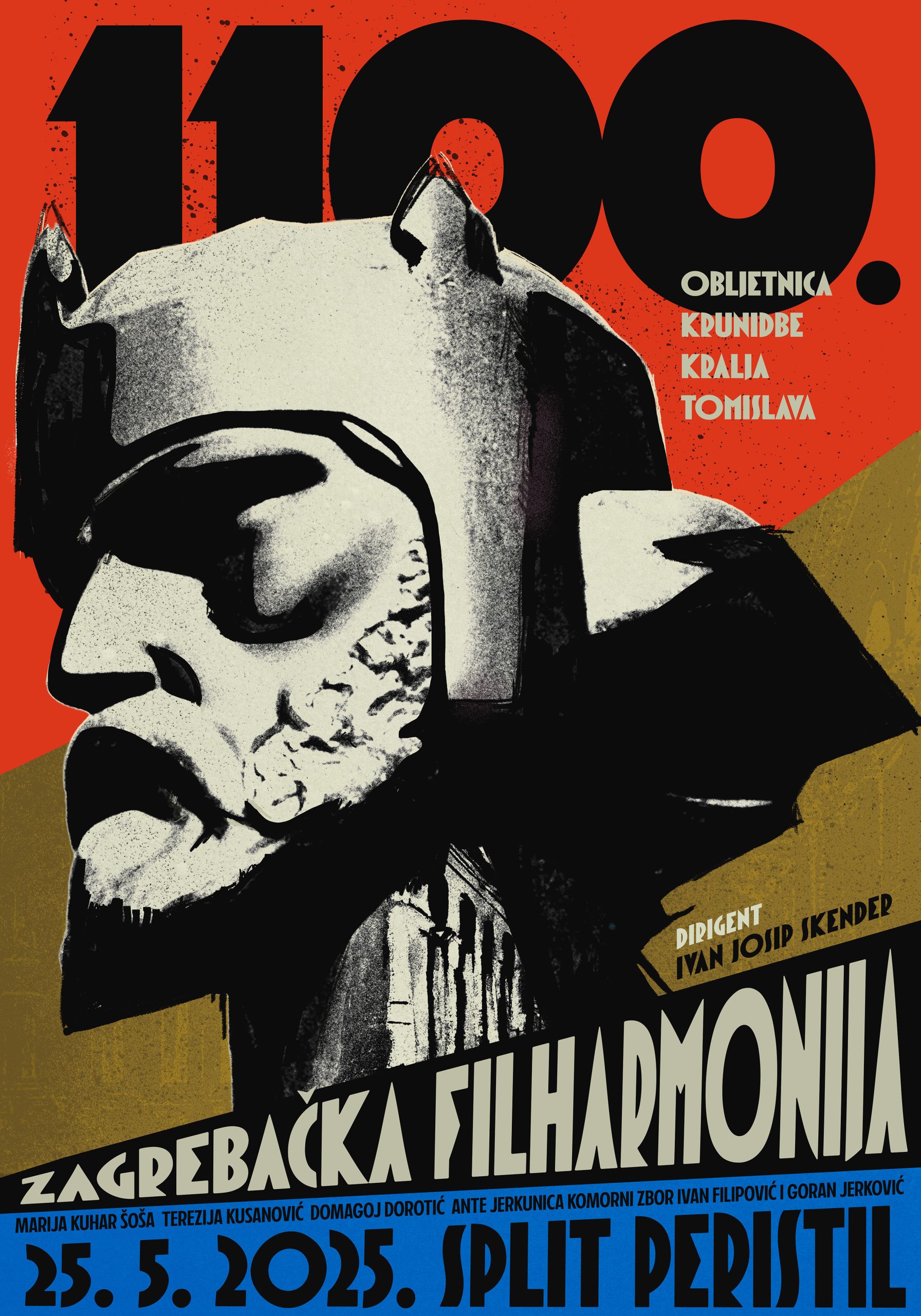

Zagreb Philharmonic Orchestra
Ivan Josip Skender, conductor
Marija Kuhar Šoša, soprano
Terezija Kusanović, mezzo-soprano
Domagoj Dorotić, tenor
Ante Jerkunica, bass
Chamber Choir Ivan Filipović, Goran Jerković – choirmaster
1100th anniversary of the Croatian Kingdom is a jubilee that marks the coronation of King Tomislav, the Croatian Kingdom, and the beginning of the Split Church Councils in Croatia, Bosnia and Herzegovina, and the Croatian diaspora through commemorations, cultural, artistic, and scientific events during 2025. [1]
On March 14, 2024, the Croatian Parliament unanimously adopted the initiative of the Society of the "Brothers of the Croatian Dragon" and the Croatian National Foundation and adopted a Decision to declare 2025 the "Year of Commemoration of the 1100th Anniversary of the Croatian Kingdom". The Ministry of Science and Education of the Republic of Croatia and the Ministry of Culture and Media of the Republic of Croatia also provided support. as well as the Government of the Republic of Croatia.[2]
The anniversary represents confirmation of the thousand-year continuity of Croatian statehood, recognition of the importance of the medieval Croatian Kingdom, an opportunity to promote Croatian cultural heritage, and an incentive for new historical research and scientific conferences. [3]
Split is the cradle of the Croatian state, the city where the First Church Council was held in 925, thanks to which we have the first documents about the existence of the Croatian Kingdom. The top of the Church and the Kingdom gathered in Split at that time, led by the first Croatian King Tomislav.
Although it is not known exactly where and when he was crowned, Tomislav held the title of king at the time of this well-documented historical event, so that year is traditionally taken as the year of his coronation.
A thousand and a hundred years have passed since then, and the Split Cathedral and the Peristyle beneath it, as ancient witnesses of those ancient events, will also be the scene of the celebration of the thousand and a hundredth anniversary of the coronation of King Tomislav.
The event will be enhanced by a concert by the Zagreb Philharmonic Orchestra, one of the oldest musical institutions in Croatia with an unbroken tradition, which is coming to Split under the direction of maestro Ivan Josip Skender. The selection of musical excerpts is marked by celebration, beginning with George Frideric Handel's dazzling Music for the Royal Fireworks, a composition composed in 1749 for the celebration marking the end of the War of the Austrian Succession, which very soon after its first performance became a widely performed work, recognizable by the sound of its brilliant fanfares. Luka Sorkočević's Preclassical Symphonies are one of the pillars of centuries of Croatian music, whose inspired, recognizable melodies and skillfully crafted forms are a symbol of the culture and beauty of the environment from which they originated. Another masterpiece of the celebratory repertoire is Wolfgang Amadeus Mozart's Coronation Mass, written on the occasion of the coronation of Francis II as Holy Roman Emperor in Salzburg in 1779. Jakov Gotovac, as the most brilliant epigon of the national style and Croatian opera of the 20th century, drew his inspiration mostly from Dalmatian folklore, both klapa singing and the harsh harmonies of the Zagora. In his sixth opera, Đerdan, composed in 1955, he draws inspiration from Dinko Šimunović's novels Đerdan and Alkar, transferring them to music of bright Mediterranean light, which is why it is often compared to Gotovac's most famous opera and called "the little Era". A representative of modernism in Croatian music, Blagoje Bersa, was one of the pillars of Croatian music of the first half of the 20th century, who brought a breath of cosmopolitanism to his works and at the same time, especially in orchestral works, found inspiration in the close landscape of his homeland. His short orchestral works, Idyll and Capriccio-Scherzo, are inspired by the composer's memories: Idyll, in which he brings some of the most memorable measures he wrote in his entire career, is a memory of his marriage and of Split, where he spent a short but idyllic youthful time after graduating from the Vienna Conservatory, and Capriccio-Scherzo is filled with irony and dark playfulness, brought by a look at various life vicissitudes. Alleluia from Handel's oratorio Messiah is a fragment of luxurious polyphony over the buoyant structures of the orchestra, which has captivated for centuries with its enthusiasm and remains one of the most performed celebratory choruses in all of musical literature.
The Zagreb Philharmonic Orchestra is joined by soloists and the Ivan Filipović Chamber Choir, whose conductor is Goran Jerković.
Music for the Royal Fireworks George Frideric Handel (1685-1759) of sublime celebratory tone, is a Baroque example of orchestral opulence. It was composed in 1749 for the celebration marking the end of the War of the Austrian Succession, an eight-year conflict between the great European powers that ended with the Treaty of Aix-la-Chapelle. In London's Green Park, the Music for the Royal Fireworks was performed at a celebration attended by more than 12 people, with a large fireworks display arranged in a Doric-style pavilion-like structure specially built for the occasion, from which a cannonade of as many as 100 cannons was to resound. The client specifically asked Handel for a score that would not include strings, as King George had an affinity for military instruments (winds and percussion). The first version thus includes only the brilliant colors of wind instruments, but the composer would also write a full orchestral version in which the piece would become widely performed, recognizable by its sumptuous fanfare theme. The entire suite consists of five movements. The opening Overture, composed in the French style, is the most famous movement, filled with strong, bright, festive tones in a grandiose manner, dotted rhythms, and fanfares.
Pre-classical symphonies Luka Sorkočević (1734-1789) are one of the pillars of Croatian music of the century, whose inspired, recognizable melodies and skillfully crafted forms are a symbol of the culture and beauty of the environment from which they originated. Luka Sorkočević was a diplomat of the Dubrovnik Republic, who was an amateur composer, leaving behind a small opus of works: in addition to nine symphonies, another three-movement overture, a duo The Lost Virtue for violin and cello with harpsichord, and two vocal pieces, an aria What a rupe in the middle of the waves and a psalm Babylonian over the rivers. Diplomatic missions also opened his eyes to the musical trends of the time, such as during his stay in Vienna, where he established connections with Joseph Haydn, Ch. W. Gluck, and the librettist Pietro Metastasio. His war symphonies, composed in the tradition of the pre-classical Italian overture, are considered the first symphonies in Croatian music. Their beauty lies in the simple elegance of the themes and the refined orchestration for strings and two pairs of wind instruments (oboes and horns). It is assumed that they were composed between 1750 and 1770. In the 20th century, they were performed and became famous in arrangements by Stjepan Šulek, but in more recent times they are performed in the original version by Sorkočević. Third Symphony in D major It is composed in three movements, the first and last are built on energetic, cheerful themes, and the middle movement contains perhaps the most famous melody Sorkočević composed, gallant and measured, yet moving and melancholic, testifying to the exceptional talent of the Dubrovnik composer.
Another superb work of celebratory ceremonial character is Misa in C major K. 317, known as Coronation Mass, Wolfgang Amadeus Mozart (1756-1791), written in Salzburg in 1779. Although it is assumed that it was performed at Easter that year, the first recorded performance of it was on the occasion of the coronation of Francis II as Holy Roman Emperor in 1792. The mass is permeated with contrasts – those in dynamics, as well as in tempos and composition, contrasting the composition of the soloists with that of the choir and the entire orchestra. The greatest contrasts occur in the central passage of the Credo movement, as well as the Hosanna passage in the Benedictus movement. Mozart achieves almost operatic effects here, and he comes quite close to opera in the Agnus Dei movement for soprano solo, in which he uses a theme that he would later use in the Countess's aria "Dove sono" in the opera The Feast of Figaro. Mozart composed a total of 17 masses. The Coronation Mass is among Mozart's most extensive settings of the Ordinary Mass. According to Mozart, in Salzburg the custom was such that a short, concise setting of the mass text was required, even during holiday Mass celebrations, but solemnly orchestrated, using the entire orchestra (i.e. including wind instruments). Therefore, the Coronation Mass in C major is an amalgam of two types of masses – it is written in the style of Missa Longa, or solemn mass, but the duration is as Missa Brevis. Mozart described his task of composing this mass in a letter: "Our church music is very different from Italian, especially since a mass with all its movements, even for the most solemn occasions when the ruler himself [the prince-archbishop] reads the mass, must not last longer than three-quarters of an hour. This kind of composition requires special training, and it must also be a mass with all the instruments - war trumpets, timpani, etc." It was to be a magnificent ceremonial setting, but also to have a compact structure. Mozart therefore omits the formal final fugues for the movements Gloria i Credo, Credo with its extensive text, it is harmonious in a solid rondo form, and Dona nobis pacem reminds of the music of the movement Kyrie.
Jakov Gotovac (195-1982) as the most brilliant epigone of the national style and Croatian opera of the 20th century, he drew his inspiration mostly from Dalmatian folklore, both klapa singing and the harsh harmonies of Zagora. Necklace, composed in 1955, is his sixth opera – it was preceded by morana, Ero from the other world, Kamenik i Milo Gojsalić, and after it he composed more operas Dalmaro, Stanac i Petar SvacicIn this opera, he found inspiration in the novels of Dinko Šimunović. Necklace i AlcarHis musical signature, a bright Mediterranean brightness radiating from a recognizable folkloric amalgam of rhythms, intervals, and colors in the orchestra, appears in a similar way in Necklace as in Eri from the other world, which is why Necklace often called "small" erom". The opera was composed at the instigation of the actor of the Komedija Theatre in Zagreb, Cvjetko Jakelić, with whom Gotovac collaborated on the libretto for three years. However, the sudden death of the young actor interrupted this work in 1951. On the eve of the fifth anniversary of the Komedija Theatre, Gotovac completed the opera. The theme is the kidnapping of a girl, a custom by which young people could achieve a marriage for love. In Necklace The wealthy landlord Gare intends to marry his sister's widow Marta's daughter, Petrica, to the wealthy merchant Ila. Even before the wedding, it is agreed that Petrica will give her necklace to Ila. Petrica runs away with her chosen one, the poor Iva, taking her necklace with her. The opera ends happily, with a wedding and wedding guests in the village.
Representative of modernism in Croatian music, Blagoje Bersa (11873-1934), was one of the pillars of Croatian music in the first half of the 20th century, who brought a breath of cosmopolitanism to his works and at the same time, especially in his orchestral works, found inspiration in the nearby landscape of his homeland. His short orchestral works, Idyll i Capriccio-Scherzo are inspired by the composer's memories: Idyll in which he brings some of the most memorable bars he wrote in his entire career, is a memory of his marriage and of Split, where he spent a short but idyllic youthful time after graduating from the Conservatory in Vienna, and Capriccio-Scherzo is filled with irony and dark playfulness, brought about by a look at the various life upheavals of one's first job. These symphonic compositions were originally conceived as part of a larger whole, a programmatically designed autobiographical symphony, Tragic Symphony – which has a subtitle Quattro ricordi della mia vita (Tragic Symphony – Four Memories from My Life), on which he began work in 1898. Idylls i Capriccio, completed in 1902, precedes Dramatic overture, completed in 1901. The last movement, Final, however, it remains only produced in a piano version.
One of the most famous fragments of a great opus George Frideric Handel je Hallelujah from the oratory The Messiah is a fragment of dazzling Baroque polyphony over the spirited structures of the orchestra, which has captivated for centuries with its enthusiasm and remains one of the most performed celebratory choruses in all of musical literature. Handel is the creator of a large operatic, oratorio and instrumental opus, luxurious in its scope as well as in the ideas he brings to it. Having spent his youth in Germany (he was born in Halle), and having spent several years living and studying in Italy, he transformed his youthful knowledge, which is based on Italian taste and style, into one of the most brilliant corpuses of music, which forms a separate entity of the vast musical heritage of the Baroque. The numerous operas that he composed, having moved to London, are today perceived as one of the most profiled Baroque operatic opuses, and when the conditions for continuing with opera production in London became unfavorable, in a burst of new creativity, as a mature composer, he founded a new recognizable genre, the English oratorio, creating a series of works that remain permanently in the repertoire. The Italian dramatic oratorios, sometimes called sacred operas, which were popular in Rome at the beginning of the century, when Handel was there (he himself composed two Italian oratorios during his stay in Rome in 1706–1710), served as a model for him, primarily Alessandro Scarlatti and his way of composing for solo voice. The most original novelty of Handel's English oratorios is the writing for choir, the variety of choirs in the oratorios, and their dominance over solo passages. The Messiah is the pinnacle of his oratorio writing. It was written in 1941 after the Ester (earlier work from 1718), Debora, Atalija, Alexander's celebration, Saul i Israel in Egypt. Messiah was first performed in Dublin in 1742, with a relatively small vocal-instrumental ensemble, and in later performances the ensemble was often considerably larger than Handel had originally intended. The text, which comes from various passages in the King James Bible and the Coverdale Psalter, was compiled by Charles Jannens, bringing the story of Jesus – from the time of the prophet Isaiah and other prophets who announced the coming of the Messiah, to the announcement of his arrival by the shepherds – a passage coming from the Gospel, while the second part of the oratorio tells of Jesus' passion and resurrection, ending with a chorus HallelujahThe third part speaks of the resurrection of the dead and the glory of Jesus Christ in heaven.
Zrinka Matić
The Zagreb Philharmonic Orchestra is an orchestra with a 150-year tradition of top-notch music making in Zagreb and Croatia, a promoter of musical art throughout Croatia, and a cultural ambassador of Croatia in the world.
This musical institution is a trademark of the city in which it operates, and embodies the urban image of Zagreb as a Central European center of music, art and culture. Professional orchestral and concert activity began in Zagreb back in 1871, and in 1920 the orchestra was given the name it still bears today.
From the very beginning, it has brought the best classical music to the Croatian capital, and its history has been written by first-class chief conductors – Friedrich Zaun, Milan Horvat, Lovro von Matačić, Mladen Bašić, Pavle Dešpalj, Kazushi Ono, Pavel Kogan, Alexander Rahbari and Vjekoslav Šutej, and in the last decade, David Danzmayr and the newly appointed Dawid Runtz. Numerous celebrated conductors have led the Zagreb Philharmonic, and Leopold Stokowski, Paul Kletzki, Sir Malcolm Sargent, Kurt Sanderling, Carlo Zecchi, Jean Martinon, Milan Sachs, Krešimir Baranović, Boris Papandopulo, Stjepan Šulek, Milko Kelemen, Igor Stravinsky and Krzysztof Penderecki are just a few of them. In the recent past, the orchestra has been led by Dmitry Kitajenko, Lorin Maazel, Leopold Hager, Valery Gergiev and Sir Neville Marriner.
The Zagreb Philharmonic Orchestra has been accompanied by numerous distinguished and world-famous musicians, including Yehudi Menuhin, Antonio Janigro, Mstislav Rostropovich, Leonid Kogan, Luciano Pavarotti, Ivo Pogorelić, Montserrat Caballe, Alexander Rudin, David Garett, Julian Rachlin, Shlomo Mintz and others. Croatian musicians who have always been happy to collaborate with the Zagreb Philharmonic include Ivo Pogorelić, Zvjezdana Bašić, Melita Lorković, Ranko Filjak, Vladimir Krpan, Pavica Gvozdić, Branko Sepčić, Stjepan Radić, Jurica Murai, Martina Filjak, Mia Elezović, Josip Klima, Monika Leskovar, Radovan Cavallin, Radovan Vlatković and many others. We should not forget the successful and popular concerts with popular Crossovers artists including Maksim Mrvica and the duo 2Cellos.
The 2011/2012 season was marked by an intensification of cooperation with maestro Dmitry Kitayenko, one of the greatest conductors of our time, which continues to this day. His work as artistic advisor to the Zagreb Philharmonic Orchestra began a new era in the orchestra's history, marked by fresh artistic enthusiasm, notable musical achievements, and major concert and recording projects.
In July 2012, the Zagreb and Slovenian Philharmonic Orchestras, with eight vocal soloists and a choir of almost a thousand singers from Croatia and Slovenia, led by the famous Russian conductor Valery Gergiev, performed a musical mega-spectacle at the Zagreb Arena. Symphony of thousands Gustav Mahler.
Since the 2012/2013 season, maestro Dmitrij Kitajenko has been working as the artistic advisor of the Zagreb Philharmonic Orchestra, achieving numerous highly professional musical achievements, to the delight of the orchestra and the audience. Under his direction, two performances of Mahler's Thousands of symphonies at the Vatroslav Lisinski Concert Hall in 2018 and even three sound recordings forOehms Classics with works by Russian masters.
The Zagreb Philharmonic Orchestra offers its concert programs to the audience in three regular subscription cycles – the Red and Blue cycles and the Off cycle, established in 2015. In the 2022/2023 season, at the initiative of Chief Conductor Dawid Runtz, the Chamber Concert Cycle was launched in cooperation with the Croatian National Theatre in Zagreb. The concerts are held on Sundays in the Foyer of the Croatian National Theatre, and feature musicians from the Philharmonic Orchestra and the Croatian National Theatre Opera. The Zagreb Philharmonic Orchestra is particularly proud of the MINIMINI cycle for the youngest, which has existed since the 2019/2020 season, and which brings concert performances for children of kindergarten and school age.
The Zagreb Philharmonic Orchestra also organizes a series of concerts outside of the cycle, some of which are charity concerts. Show love organized by the Zagreb Philharmonic Orchestra and the Rotary Club 1242, which collects funds to help with the treatment of the youngest, a traditional humanitarian event Concert for Life in Memory of Ana Rukavina and Maestro Vjekoslav Šutej with which the Philharmonic supports the work of the Ana Rukavina Foundation and Philharmonic Ball with which the orchestra bids farewell to the old year and welcomes the new. The Zagreb Philharmonic Orchestra is also a permanent partner of humanitarian actions Koracle in life and every year organizes a concert for all participants in the campaign and citizens who, by purchasing tickets, help raise funds intended for scholarships for young people from homes for neglected children and foster families.
The Zagreb Philharmonic Orchestra regularly participates in the programs of the Dubrovnik Summer Festival and the Zagreb Music Biennale, and every year it collaborates with the Zagreb Academy of Music, thus providing future musicians with the opportunity to prove themselves on the big concert stage.
In the last few seasons alone, the orchestra has performed in Argentina, Oman, Kuwait, China, Vienna, Lisbon, Budapest, Warsaw, Krakow, Moscow, Leningrad, Rome, Dresden, Zurich, Milan, Great Britain and Israel. New Year's Eve concerts in Salzburg have been an indispensable part of its concert season, and in February 2016, the Philharmonic performed at the most prestigious American music stage - New York's Carnegie Hall. The orchestra also performs regularly in its homeland, from Vukovar and Đakovo, through Istria, to Split and Dubrovnik.
Ivan Josip Skender (Varaždin, 1981), composer and conductor, is a versatile musician with a very wide spectrum of activities. He enrolled in the study of composition in 1997 at the Academy of Music in Zagreb in the class of Prof. Željko Brkanović as the youngest composition student in the history of the Academy, and in 1999 he also studied conducting in the class of Prof. Vjekoslav Šutej, and later improved his skills through postgraduate studies in Vienna with Uroš Lajovic, and through seminars and workshops in composition (Michael Jarell, Joszef Soproni) and conducting (Klaus Arp, Bertrand de Billy, Zubin Mehta, etc.). He was the first composer to represent Croatia at the European multimedia festival MusMa (Music Masters on Air) in 2012. He is a scholarship laureate Rudolf and Margita Matz for young composers. His broad and versatile oeuvre includes around 120 compositions for soloists, chamber ensembles, orchestras, choirs, music for theatre performances, musicals, operas Striborova forest (with its 27 performances, by far the most performed biennial opera).
As a conductor, he has collaborated with numerous Croatian and foreign ensembles, and is particularly dedicated to performances and premieres of compositions by contemporary Croatian authors. As a conductor, he has performed or premiered several hundred compositions by contemporary Croatian composers, with almost all ensembles in the Republic of Croatia, and some of the performances have been released on sound carriers. Members of the Contemporary Music Ensemble Cantus they elected him as permanent conductor in 2012.
From 2005 to 2019, he was employed at the Croatian National Theatre Opera in Zagreb as a choirmaster and conductor. He was also the acting director of the Croatian National Theatre Opera in the 2013/2014 season. Since 2009, he has been an assistant to Prof. Uroš Lajovic at the Zagreb Academy of Music, and since 2019, he has been permanently employed at the Academy of Music, where he holds the title of associate professor at the conducting department. He has received multiple awards and incentives for his artistic work, including the Rector's Award, the Stjepan Šulek and the prize Papandopoulo for composition, award milka trnina for conducting an opera Lennon Ivo Josipović, and the award Vladimir Nazor for the entire artistic work.
Since 2019, he has been a member of the artistic leadership of the Zagreb Music Biennale, and since 2023, one of its artistic directors. In 2020, he was appointed a member of the assembly of representatives of the Croatian Composers' Society. Since 2024, he has been an associate member of the Croatian Academy of Sciences and Arts.
Marija Kuhar Šoša She graduated in 2006 from the Music Academy in Zagreb, in the class of Lidija Horvat-Dunjko. During and after her studies, she won numerous awards and recognitions in Croatia and abroad, including: The Croatian Theatre Award 2007, The Marijana Radev (season 2008/2009) and the Zagreb Philharmonic Award for Best Young Musician in 2009. She has performed in numerous roles at the Croatian National Theatre in Zagreb (Susanna, Zerlina, Pamina, Lauretta, Adina, Adele, Norina, Musetta, Jelena, Gretel, Oscar, Constance, Nanetta…). She has guested in Italy, Germany, Spain, Israel, Austria, Slovenia, Serbia and Albania. She has achieved notable performances in numerous concert projects and oratorio productions. In 2011, she performed at the opening of the festival Julian Rachlin and friends in Dubrovnik with the Belgrade Philharmonic Orchestra conducted by Zubin Mehta. She performs with Croatian and foreign orchestras (Zagreb Philharmonic, Croatian Radio and Television Symphony Orchestra, Cantus Ensemble, Zagreb Soloists, Croatian National Theatre Zagreb Opera Orchestra, Dubrovnik Symphony Orchestra, Croatian Baroque Ensemble, Slovenian and Belgrade Philharmonic Orchestras). Among the conductors she has collaborated with are Pavle Dešpalj, Ivo Lipanović, Nikša Bareza, Vjekoslav Šutej, Ivan Repušić, Vladimir Kranjčević, Aleksandar Kalajdžić, Uroš Lajovic, Antonello Alemandi, Johannes Wildner, Lothar Zagrosek, Marko Letonja. She has performed at the Dubrovnik Summer Festival, Split Summer, Musical Evenings in St. Donatus in Zadar, Osor Musical Evenings, Varaždin Baroque Evenings, the Festival Heferer organ and Scena Amadeo. From 2006 to 2009, she was a scholarship holder of CEE Musiktheater and Deutsche Bank. Until 2022, she was an assistant professor at the Juraj Dobrila University Academy of Music in Pula, and since 2020, she has been a titular assistant professor at the Academy of Music in Zagreb. Since 2022, she has been a member of the opera ensemble of the Croatian National Theatre in Zagreb and its first conductor.
Terezija Kusanovic, mezzo-soprano, Croatian opera and concert singer, first lady of the Croatian National Theatre Split, assistant professor of solo singing at the Split Academy of Arts, was born in Split where she completed her musical education. After graduating in music pedagogy, she enrolled in the study of solo singing with Prof. Nelli Manuilenko. She graduated in opera and concert singing and vocal pedagogy. Later, under the mentorship of Prof. Manuilenko, she obtained a Master of Arts degree at the Zagreb Academy of Music, while simultaneously attending master classes with renowned vocal pedagogues and artists.
After a series of roles in opera productions at the Academy of Arts, she began her professional career as a singer with the lead role of Judita in Frane Parać's opera of the same name, premiered at the Croatian National Theatre Ivan pl. Zajc in Rijeka.
Her repertoire includes roles such as Carmen, Dalila, Preziosilla Azucena, Fenena, Maddalena, Ulrica, Amneris, Suzuki, Lola/Santuzza, Klytaemnestra, Adalgisa, Rosina, Cieca/Laura, Lukrecija, Eboli, Eva, Melka, Orlovski Doma, Jele, Didona, Orfej, Mary and others, most of which she performed on the stage of the Croatian National Theatre Split as well as at the Split Summer Festival, and while guesting in other Croatian national theatres, as well as in Italy, South Korea, Bosnia and Herzegovina, Slovakia, Austria, etc.
Terezija Kusanović has collaborated with renowned conductors such as Nikša Bareza, Nada Matošević, Ivo Lipanović, Ivan Repušić, Mikhail Sinkeevič, Valerio Galli, Gianluca Martinenghi, Marco Baldieri and Marco Boemi, and with famous directors such as Petar Selem, Krešimir Dolenčić, Dora Ruždjak Podolski, Karla Štaubertova, Ozren Prohić, Ivo Guerra, Michael Znaniecki, Francesco Belotto, Fabio Sparvoli, Georgij Paro and Robert Bošković.
In addition to opera, she also cultivates concert singing. In 2020, she founded Mediterranean Project: a vocal-instrumental story in the rhythm of rapture and passion. The aim of the project was to compose music and find new arrangements for some eternal melodies and popular titles of the Mediterranean music circle.
She won the Second Prize at the Prof. Dichler Competition in Vienna and a special prize Fruits of Verdiana (Albenga – Italy). The Croatian National Theatre Split awarded her the award Ante Marusic for exceptional artistic operatic achievements in two seasons, for the roles of Carmen and Dalila. She is the recipient of the award Porin for a klapa album DisperadunShe recorded a CD. Romance with solo songs and song cycles by great domestic and foreign composers of the 19th and 20th centuries, as well as opera arias. A CD of the German Lieda with piano accompaniment by Vesna Podrug Kossjanenko. She is an assistant professor of solo singing at the Academy of Arts in Split.
Tenor Domagoj Dorotić He began his musical education as a trumpet player at the Music School. Ferdo Livadic in Samobor, then he graduated from secondary music school Elly Basic. He studied solo singing in the class of Vlatka Oršanić at the Zagreb Academy of Music, where he graduated in 2008. Two years later, he became a soloist of the Croatian National Theatre Opera in Zagreb, where, among others, he performed roles in the operas Nikola Šubić Zrinjski by Ivan pl. Zajc (Juranić), Mazeppa by Pyotr Ilyich Tchaikovsky (Andrei), Gianni Schicchi by Giacomo Puccini (Rinuccio), Hamlet by Ambroise Thomas (Laert), L'Eau de Lisboa by Gaetano Donizetti (Nemorino), Eugene Onegin by PI Tchaikovsky (Lenski), Tosca by G. Puccini (Cavaradossi), and Equinox by Ivan Brkanović (Ivo). At the same time, he performed at the Split Croatian National Theatre Opera in the operas Macbeth by G. Verdi (Macduff), Adel and Mara by J. Hatze (Adel), Nabucco by G. Verdi, Cavalleria rusticana by P. Mascagni (Turiddu), Traviata by G. Verdi (Alfredo), The Haunted Dutchman by R. Wagner, Ernani by G. Verdi, etc. He has been a guest at the Lithuanian National Opera in Riga, and since 2015 he has been engaged as a leader at the Osijek Croatian National Theatre Opera, where he has performed in the leading roles of premiere performances of the operas; Porin (Porin), Manrico (Troubadour), Don José (Carmen), etc. He regularly performs in concert, collaborating with our prominent conductors and ensembles, performing oratorio works such as Verdi's Requiem, Beethoven's Missa solemnis, Dvořák's Stabat Mater, Mahler's symphonic cycle Songs about the country etc. He participated in concert performances and recordings of operas Love and malice V. Lisinski, who is also the winner of the award Porin, Nikola Šubić Zrinjski Ivan pl. Zajc and cantatas Praise Boris Papandopulo produced by HRT. Notable performances include presenting Croatian culture in Manaus, Brazil, performing Glagolitic Masses Leoš Janáček with the Royal Philharmonic Orchestra of Liège and the opening of the Dubrovnik Summer Festival. Among the awards, the following stand out: the Rector's Award for the role of Rinuccio (Gianni Schicchi, 2008), the first prize of the jury at the Summer Opera Seminar in Schloss Laubach (2008), the Croatian Actors' Association Award for the role of Max (Srećko Bradić's Crux dissimulata) and Fenton (Falstaff, 2009), the awards Ante Marusic Split Croatian National Theatre and Vladimir Ruždjak of the Zagreb Croatian National Theatre for the role of Cavaradossi (2012). He also won the Award milka trnina Croatian Society of Musicians for special artistic achievements in 2022. In 2023, he also received the Croatian Theatre Award in the category of musicals and operettas as the best male role in an operetta Bat for the role of Eisenstein. Since 2015, he has been engaged as the principal of the Opera of the Croatian National Theatre in Osijek, then the principal of the Opera of the Rijeka Croatian National Theatre Ivan pl. Zajc in Rijeka, and since 2022, he has been the principal of the Opera of the Croatian National Theatre in Zagreb. where he has performed many leading roles, among which the role of Eisenstein in the operetta can be highlighted. Bat , the role of Pinkerton in the opera Madame Butterfly, the role of Lennon in Ivo Josipović's modern opera Lennon, the role of Era in the opera Ero from the other world and others.
Born in Split, bass Ante Jerkunica, is one of the most sought-after basses on the international stage. He regularly performs in major opera houses and festivals such as the Deutsche Oper in Berlin, the Bavarian State Opera in Munich, the Vienna State Opera, the Salzburg Festival, the Teatro Real in Madrid and the Metropolitan Opera in New York.
He began his career at the Croatian National Theatre in Split in 2002. He was engaged at the Deutsche Oper in Berlin, where he sang various bass roles, from bel canto to Wagner, including Fiesco, Philip II, Father Guardian, Banco, Alvise, Rodolfo, Sarastro, Marcello, Gremin, Pimen, Fafner, Hunding, King Marke and Daland. In parallel with his career in Berlin, his international career was on the rise, with guest appearances at prestigious opera houses in Frankfurt, Leipzig, Cologne, Hamburg and Zurich, the Paris National Opera, the Lyon Opera, the Bilbao Opera, the Teatro San Carlo Lisbon, the Vienna State Opera, the Theater an der Wien and operas in Amsterdam, Antwerp and Seattle.
He has regularly collaborated with the Teatro de Liceu Barcelona, La Monnaie in Brussels and the Opéra National du Rhin in Strasbourg, where he has interpreted a series of significant and critically acclaimed roles: Bluebeard, Gurnemanz, The Inquisitor, Fafner and Fasolt, Hunding, Saltan, Sparafucile and Balthazar. His role as Vodník in Rusalka at the renowned Teatro Colon in Buenos Aires won him the Audience Award for Best Opera Performer of the 2017/18 season. In 2017, he sang the role of Prince Ivan Khovansky in Khovanshchina at the Royal Albert Hall in London at the BBC Proms.
The COVID-19 pandemic briefly postponed a number of important performances, including the Glyndebourne Festival in the UK, the Aix-en-Provence Festival and three productions at the Metropolitan Opera in New York; in spring 2022 he made his Metropolitan Opera debut as Sparafucile in Rigoletto. He has frequently performed in prestigious European concert halls, such as the Berlin Philharmonic, the Concertgebouw Amsterdam, the Konzerthaus Vienna, the Konzerthaus Berlin, etc. He has also collaborated with renowned conductors, including Riccardo Muti, Kirill Petrenko, Semyon Bychkov, Ivor Bolton, Marc Armiliato, Sir Mark Elder, Kent Nagano, Adam Fischer, Sir Donald Runnicles, Marc Albrecht, Michael Jurowski, Alexander Vedernikov, Bertrand de Billy, Alain Altinoglu, etc. He has successfully collaborated with prominent opera directors, such as Robert Carsen, Calixto Bieit, Dmitry Chernyakov, David Alden, Casper Holten, Àlex Ollé, Hans Neuenfels and Romeo Castellucci.
This season began with a repeat performance in Rigoletto at the Metropolitan Opera, and continues with performances with the Munich Radio Orchestra (mazeppa), at the Vienna State Opera (Don Giovanni, Abduction from the palace), Flemish Opera (Norma), Semperoper in Dresden (Elf Archer, Abduction from the palace), Teatro Real in Madrid (The Tale of Tsar Saltan), as well as their first appearance at the Bregenz Festival (Oedipus) in July this year, while performances at La Monnaie in Brussels, Semperoper in Dresden and the Théâtre des Champs-Elysées in Paris have been announced for the next season.
Chamber Choir IVAN FILIPOVIĆ was founded in 1998. For more than 25 years, it has been operating under the artistic leadership of its founder, artistic director and conductor, maestro Goran Jerković.
The choir is known for its carefully thought-out program and high level of its performances of compositions from the treasury of world and Croatian choral heritage, from the Renaissance to contemporary choral music. Since the beginning of its activities, the choir has distinguished itself as one of the most successful a cappella ensembles in Croatia, which is confirmed by numerous praises and positive reviews from reputable music experts, awards at domestic and international competitions (in Hungary, Italy, Germany, China, Turkey, international online choir competition Queen of the Adriatic Sea), collaborations, art projects, concerts, concert tours and guest appearances on numerous Croatian and world stages (Israel, Taiwan, Bulgaria, France, USA, Great Britain, Spain, Slovakia, Macedonia, etc.).
The choir has also performed more than forty major works in collaboration with numerous prominent Croatian and international ensembles and conductors, independently or together with other choirs (works by A. Vivaldi, A. Campra, J. Gilles, J. S. Bach, M.-A. Charpentier, WA Mozart, J. Haydn, GF Handel, A. Bruckner, C. Orff, G. Mahler, A. Rahbari).
In the recording industry, CDs stand out A cappella (2003), CD/DVD edition titled Dieterich Buxtehude: "Membra jesu nostri" (2010), audio and video production Premieres at the Croatian Academy of Sciences and Arts (2013 on the occasion of the 15th anniversary of the Choir).
An exceptional place in the history of the KZIF is occupied by the invitation and participation in the International Choir Festival. The Rhythms of One World 2015 in New York in 2015 and an appearance before the United Nations General Assembly to mark the 70th anniversary of the signing of the United Nations Charter in the presence of ambassadors and diplomats from around the world.
Celebrating its 25th anniversary, the Chamber Choir "Ivan Filipović" presented its rich artistic biography in a valuable printed edition by publishing a monograph in 2024. 25 years of excellence.
Georg Friedrich Händel: Overture from Music for the Royal Fireworks
Luka Sorkočević: Symphony No. 3 in D major
Wolfgang Amadeus Mozart: Coronation Mass in C major, K. 317
Jakov Gotovac: Overture to the opera Necklace
Jakov Gotovac: My necklace, my girl's necklace, Petrica's aria from the third scene of the opera Necklace
Blagoje Bersa: Idyll for orchestra, op. 25a
Blagoje Bersa: Capriccio – Scherzo for orchestra, op. 25c
Georg Friedrich Händel: Hallelujah from the oratorio The Messiah