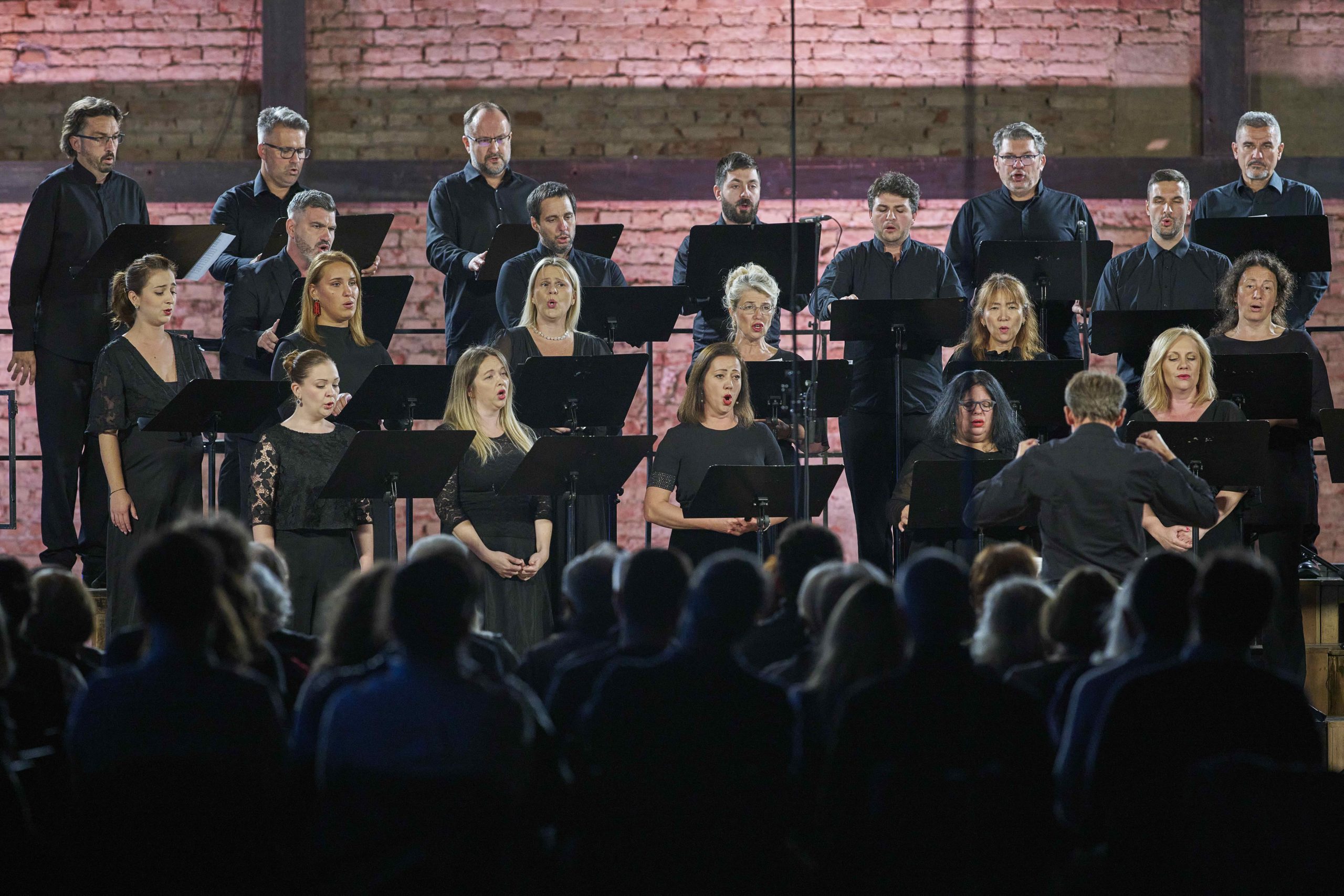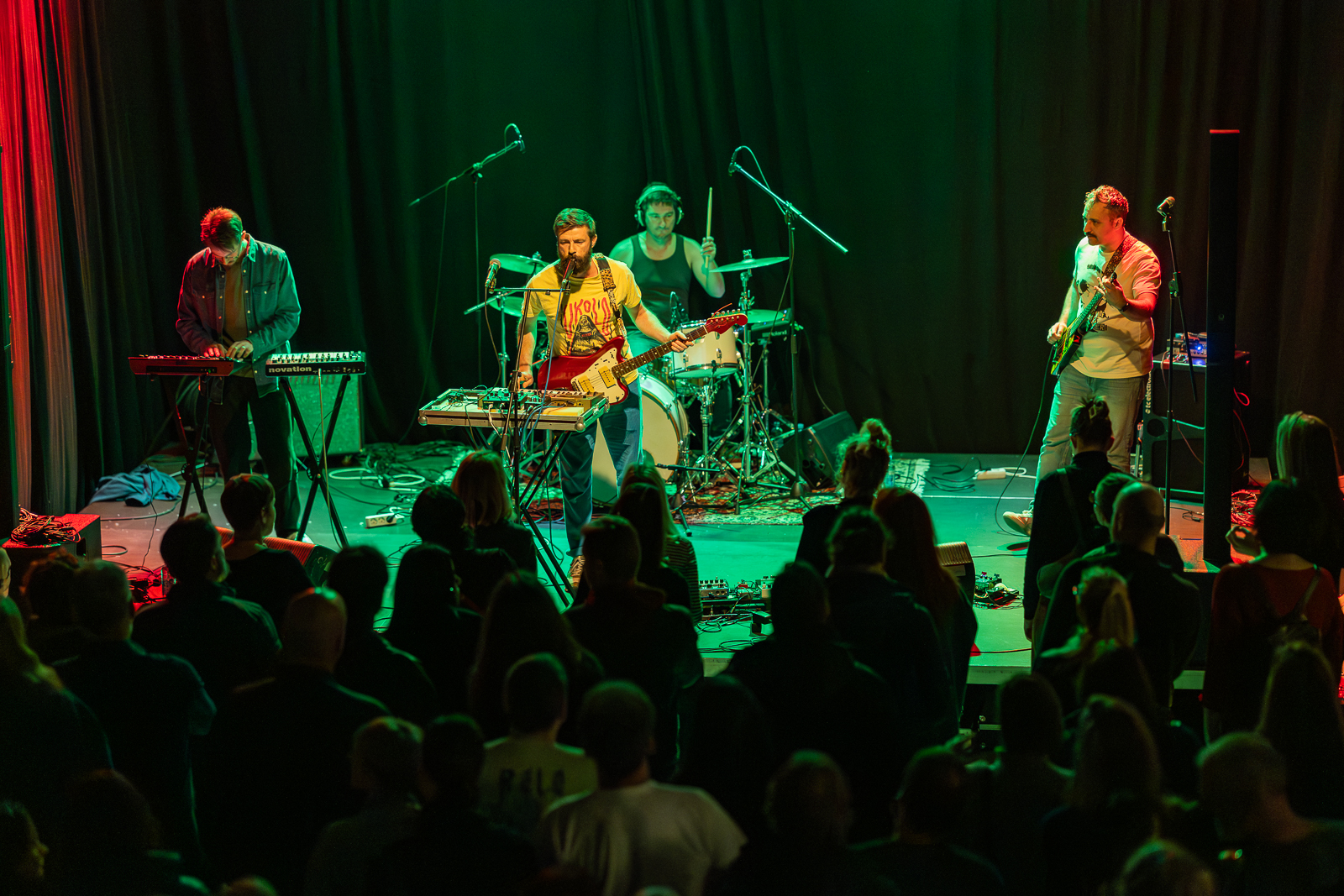
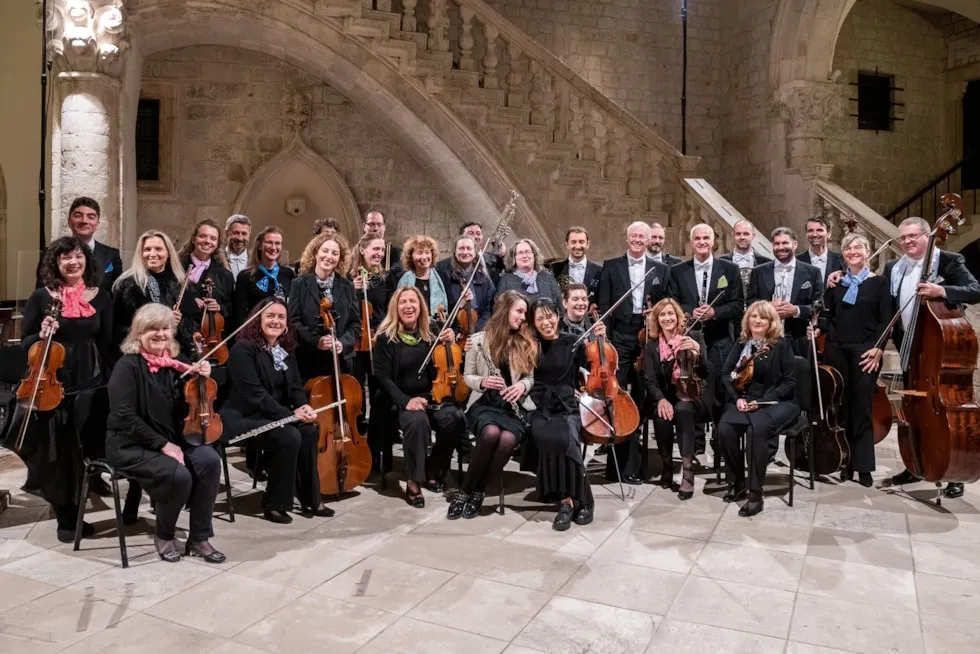
In 2022, the Dubrovnik Symphony Orchestra celebrates its 97th anniversary of active work. He presents his musical repertoire and an inexhaustible source of quality cultural events in spaces such as the atrium of the Duke's Palace, city churches and squares. He regularly performs with famous domestic and internationally recognized artists, interpreting the works of famous composers in Dubrovnik and on tours around the world. The orchestra is the winner of awards such as Milka Trnina (2005), Award for contribution to the reputation and promotion of the Dubrovnik-Neretva County in the country and the world (2015) and the Grand Prix Orlando award for special artistic contribution at the Dubrovnik Summer Games (2020).
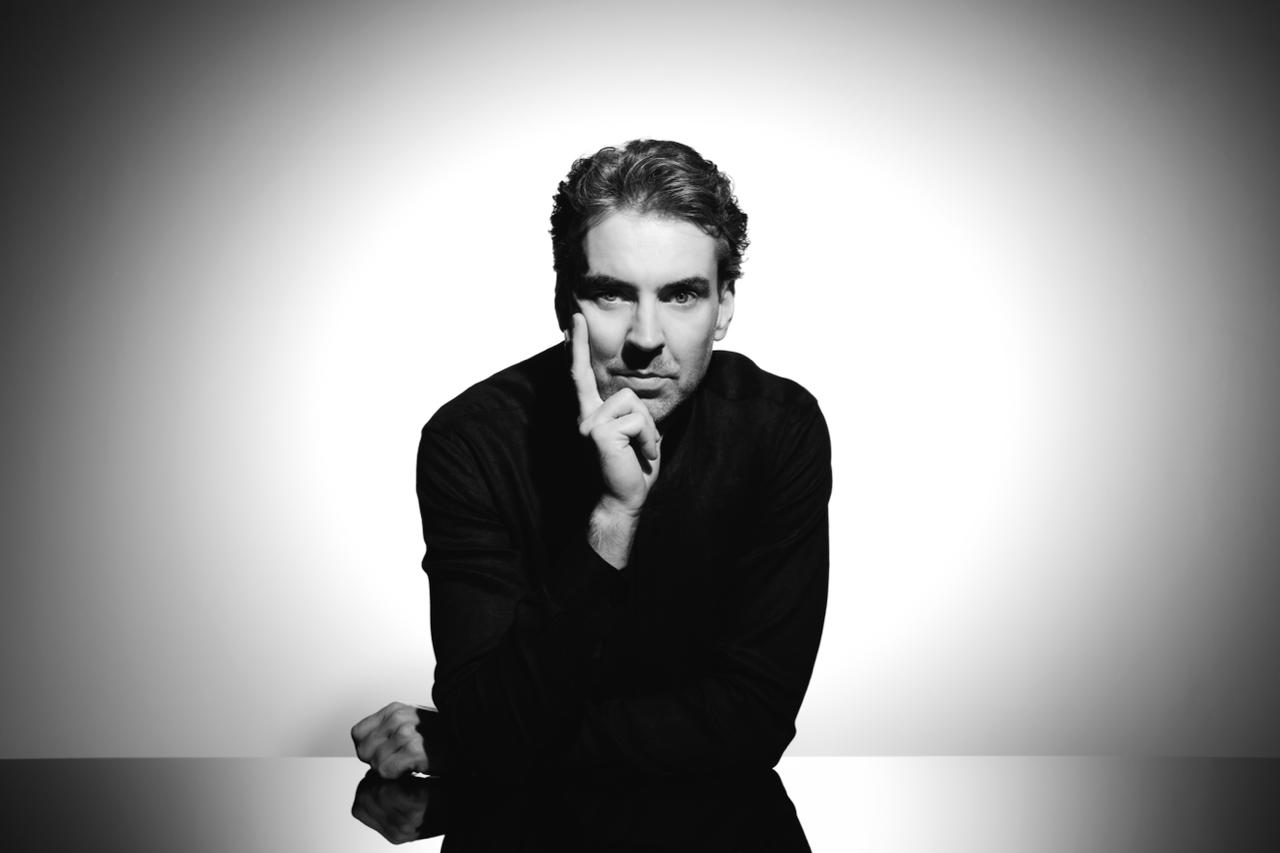
Ivan Hut (1982) has been the conductor of the Dubrovnik Symphony Orchestra since December 2020. He graduated in conducting and master's degree in Hans Leenders' class at the Codarts University of the Arts in Rotterdam, and before that he graduated in viola at the Music Academy of the University of Zagreb. He trained with numerous conductors, including Valerij Gergiev. He was a professor at the Josip Hatze School of Music in Split, a member of the Split Chamber Orchestra, president of the Split MAG Association, producer and then director of the music program Split Summer and director of the Opera of the Croatian National Theater Split. Among his most important orchestral collaborations were those with the Rotterdam Symphony (at the Concertgebouw in Amsterdam), the Zagreb Philharmonic, the HRT Symphony Orchestra, the Zadar and Varaždin Chamber Orchestras, and the Guanajuato University Symphony Orchestra from Mexico.
Sinfonietta for string orchestra, Op. 79, is one of the most famous and performed works of Boris Papandopoulos. It was written in the summer of 1938, and it was first performed in September of the same year by the Zagreb Philharmonic under the direction of Krešimir Baranović, who convinced the young composer to discard the second movement of the work (Scherzo), so the Sinfonietta was performed in a three-movement version, that version published by Schott & Söhne. The Sinfonietta has no direct allusions to folk music; it is characterized by a cosmopolitan musical idiom typical of the European "neo" styles of that period. The first movement of the Intrada march has a Mediterranean character, full of sun and joy. After the striking gesture of "raising the curtain" typical of the Baroque overture, the presentation of the main theme follows, first in the violins, and later in the violas. This bright mood is temporarily "darkened" by a formal fragment, which will briefly return later. The elegy is a freely conceived baroque da capo aria in neoclassical form, during which solo sections (here entrusted to the solo violin) alternate with orchestral passages. The underlying formal scheme is far more complex, as the contrapuntal sections of the orchestra and soloists alternate more often than tradition requires. The final movement of the Perpetuum mobile is an exciting swirl of notes, a dazzling toccata that opens with pulsating figures that pulse throughout the movement. In the furious finale, Papanpdopulo briefly returns to the Intrade motif to complete the work's motivic fabric. The light, light-hearted musical rapture and youthful charm of this euphoric composition still make it a favorite piece among concert audiences. (Davor Merkaš)
Luka Sorkočević (1734 - 1789) is one of the most famous Croatian composers of his time. He was a Dubrovnik nobleman, diplomat and composer. He comes from an old Dubrovnik patrician family, whose members were highly educated and known as writers and scientists. Sorkočević studied in Rome, where he was able to deepen his musical knowledge with the composer Rinaldo di Capua, while encounters with Italian instrumental music of that era undoubtedly influenced his creativity. Returning to Dubrovnik, he participates in the public affairs of the Republic, and teaches his son Antun music. The preserved works of Luka Sorkočević are stored in the Music Archive of the Monastery of the Little Brothers in Dubrovnik. His musical legacy includes seven completed symphonies, one harpsichord sonata/symphony, one overture and several other instrumental works and two vocal compositions. The most interesting are certainly his symphonies, which are early examples of the pre-classical style in Croatian music. Like all the others, the Third Symphony in D major exudes loveliness and lively movement and the emotional warmth of the middle movement. This symphony is certainly one of the most performed works of Croatian musical heritage, and its third movement owes its popularity to its performance on small screens.
Krsto Odak (1888 - 1965) joined the Franciscan order after graduating from the Franciscan Classical High School in Sinj. In 1912, the Provincial of Makarska sent him to study for two years at the Monastery of St. Anne in Munich. Until then, mostly self-taught, Odak began studying the organ and composition with the composer and conductor Paul Hartmann. After returning to Croatia in 1913, Odak became an organist and singing teacher at the seminary in Sinj, then pastor of Otok, and in 1919 he left the order in order to continue his music studies. He chose Prague, where he studied composition in the class of Vítězslav Novák. He returned to Zagreb in 1922 and began teaching at the Academy of Music, where he taught composition from 1934 until his retirement in 1961. His opus of over 350 works reflects the diversity of styles in Croatian music of the first half of the last century: from late romantic expressionism, through modernity to the national style and the first signs of new music in the middle of the century.
The first passacaglia for string orchestra op. 35 was originally composed for organ as Passacaglia op. 34c, in the form of baroque variations, i.e. a theme that is brought in the bass, and from which the polyphonic variations in the higher sections branch off, each time in a new form. Passacaglia consists of twenty variations, which Odak himself reworked as opus 35 for string orchestra. The composition is in a traditional neo-baroque mood, a firm G minor, which ends in the baroque style with an enlightening fifth chord in G major.
Gordan Tudor (1982) is one of the leading musicians of his generation, active as a soloist, composer, chamber musician and educator. He performed in Europe and North America in various chamber ensembles and as a soloist with many orchestras and ensembles. Gordan is the alto saxophonist of the acclaimed Papandopulo Quartet and works in a duet with guitarist Mislav Režić. As a reproduction artist, he premiered fifty compositions by Croatian and foreign authors, as a composer he tried his hand at various genres and combinations of instruments, and his compositions were performed on all continents. He spent the summer of 2011 at the residency as part of the Bang on a Can summer festival - Massachusetts Museum of Contemporary Art (North Adams, MA). Gordan is an exclusive Selmer Paris Artist and D'Addario Woodwinds Artist.
The composition Lamento and Boogie was created at the beginning of 2021 and is actually part of a diptych, which is the result of my intense composing for strings at the time. This work was created as a by-product. Namely, the deadline for the composition that the Music Biennale Zagreb commissioned from me for the Zagreb soloists was approaching, so I sketched various ideas. The idea of a slow movement, Lament, which has a constant melodic, harmonic and dynamic growth and a fast Boogie "glued" to it, an extremely (poly)rhythmic part, was coherent to me from the beginning. I immediately showed the sketch of the piece to maestro Ivan Huto, who liked it, and that's how Lamento i Boogie was born, eventually dedicated to maestro Huto and the strings of the DSO. (Gordan Tudor)
Boris Papandopulo (1906 - 1991) spent three years of his life (1935 - 1938) in Split, where he worked as a teacher at the City Music School and choirmaster of the Croatian Singing Society Zvonimir, and at the same time from 1936 to 1938 and as a music teacher at the Dominican high school in Bol. At that time, he composed the operas Amfitrion and Sunčanica, and the oratorio The Passion of Our Lord Jesus Christ for soloists and a capella male choir, and the Sinfonietta were also composed in Split.
Luka Sorkocevic:
Third Symphony in D major
Allegro
Walking
Presto
Krsto Odak:
First passacaglia for string orchestra, op. 35
Gordon Tudor:
Lament and boogie for string orchestra
Boris Papandopoulo:
Sinfonietta for string orchestra, Op. 79
Intrada: Festivo, Tempo di marcia
Elegia: Andante sostenuto, semper molto espressivo e dolorosamente
Perpetum mobile: Presto