
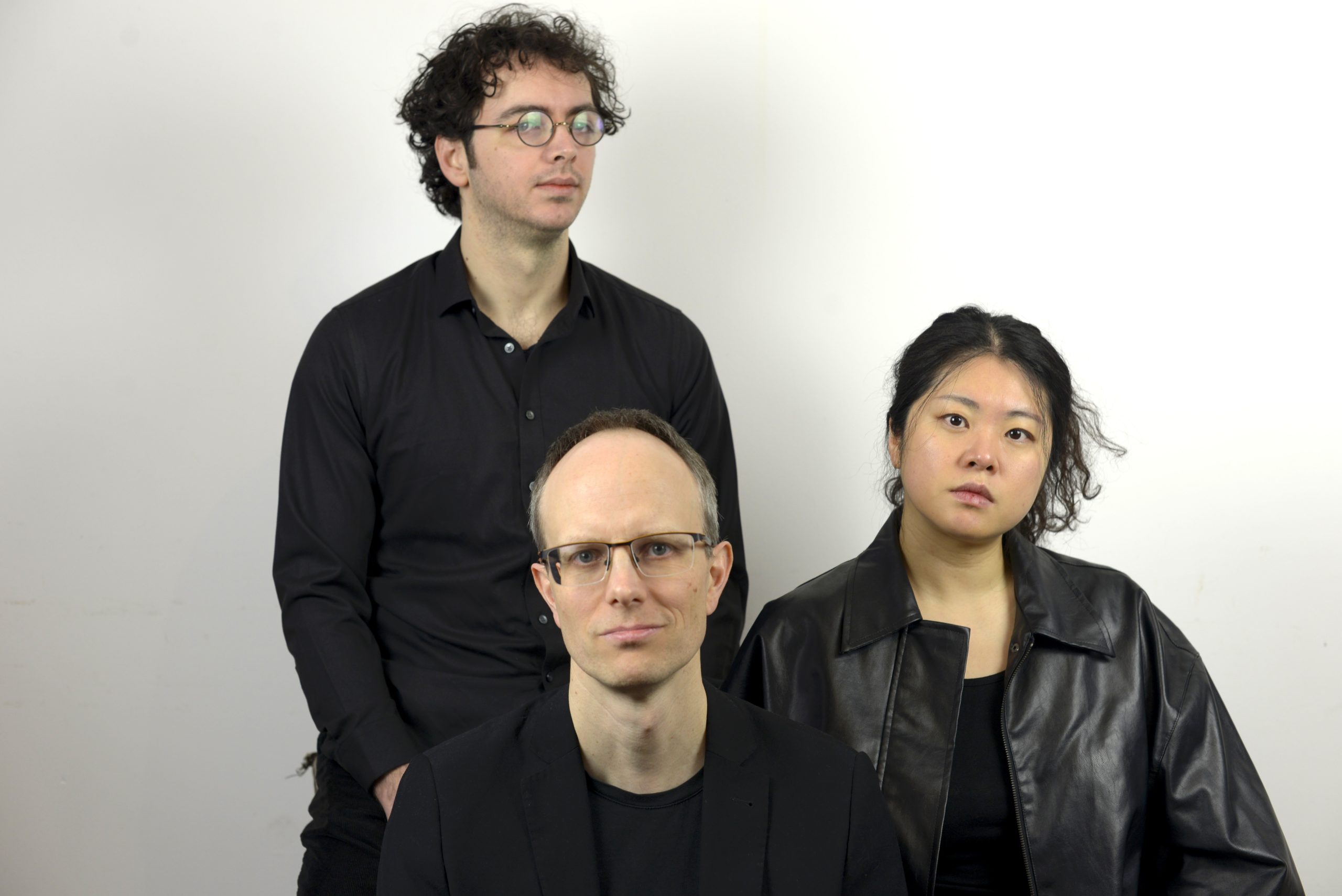

Philipp Rüttgers - piano
Omer Govreen - double bass
Sun-Mi Hong - drums
Philipp Rüttgers Trio brings the project Re: Satie – Picturing the Invisible , a contemporary jazz reading of the music of Erik Satie, one of the most original and enigmatic composers of French music.
Drawing on Satie's distinctive melancholy, transparency, reduction and subtle humor, German pianist and composer Philipp Rüttgers translates his musical ideas into the sound world of a contemporary jazz trio. Instead of classical arrangements, Rüttgers uses motifs and fragments from Satie's oeuvre as material for building entirely new musical entities.
For the project, he studied the complete edition of Satie's compositions and rearranged and shaped selected fragments, melodic outlines and harmonic ideas. The result is music in which Satie's abstract and enigmatic aesthetics naturally merge with contemporary jazz language, improvisation and the trio's personal authorial expression.
Rüttgers does not only stick to the well-known Gymnopédies and Gnossiennes , but also reaches for less performed works such as Le Fils des étoiles and Uspud , created during Satie's mystical and esoteric period.
Satie's penchant for simplicity and reduction is also strongly reflected in the way the trio approaches the music: fewer tones can carry greater expressive power, while at other times the music opens up to more complex rhythmic and harmonic structures. It is in this space that an extremely sensitive communication emerges between Rüttgers' piano, Omer Govreen's double bass, and Sun-Mi Hong's drums.
The silence, pauses and spaces between tones are as important in this project as the tones themselves. It is in these unspoken spaces that the trio attempts to "paint the invisible" – the hidden tensions, harmonies and structures that give Satie's music its enduring mystery.
About the project Re: Satie – Picturing the Invisible
The project starts from the idea that Satie's music is not reconstructed, but reimagined. Philipp Rüttgers views his motifs as musical fragments from which new stories can be developed, while retaining the original atmosphere, melancholy, irony and sense of incompleteness.
Contemporary jazz vocabulary is present unobtrusively, and the trio's shared sound formation plays a key role. Rüttgers, Govreen and Hong listen to each other, build balance without forcing it, and use transparency as an important element of musical expression.
In this sense, Re: Satie is not a homage in the usual sense, but a creative dialogue with a composer whose musical world, even more than a century later, proves to be surprisingly contemporary.
All information about discounts is available here.