
Johann Sebastian Bach (1685-1750) was a composer whose modesty and dedication to music transcended his personal fame, devoting himself to learning, performing, and creating works that remain timeless today. His famous Italian Concerto was published in the modestly titled collection Claiverübung – "piano exercise." This title conceals a wealth of music, published in four volumes, from 1731 to 1741, including his six partitio BWV 825-230, the chorale preludes BWV 669-689, and the Goldberg Variations.
The Italian Concerto BWV 971 was published in 1735 in the second volume, intended for the two-manual harpsichord, which Bach described on the title page: "A piano exercise consisting of a concerto in the Italian taste and an overture in the French manner for the two-manual harpsichord, composed for music lovers to refresh the spirit, by Johann Sebastian Bach, Kapellmeister to His Majesty the Prince of Anhalt-Cöthen and director of the Chori Musici Lipsiensis." In the first part of the volume – the Italian Concerto, Bach actually imitated the form of the concerto grosso on the solo instrument, the two-manual harpsichord, i.e. the tutti orchestral passages and the passages usually played by the soloist (or a small group – concertino), and conveyed the idea of a lively Italian type of concerto that is harmonious in the order of movements fast-slow-fast. Bach's masterful arrangement of tonal strengths and sound density is best heard on a two-manual harpsichord, but today the concerto is most often played on the piano, where manipulation of tone and the striking formation of contrast are necessary to clearly convey Bach's idea. The outer movements carry a vivacity and bright color, with much vitality and energy characteristic of the performance of the entire ensemble; the tutti present the theme, to be taken over by the soloist who also performs the cadenzas, and a real competition between the tutti and the solo fragments follows, which requires resourcefulness and sensitivity on the part of the performer. In the middle movement, a long "solo" melody appears that moves continuously, developing in contours that are constantly being built up, filled with fine ornamentation, over side lines and bass tones that imitate the basso continuo. The third movement seems to bring a rapid play between the instruments, the play of the solo and the orchestra in developed motivic work and fast, ingenious polyphony, which results in a brilliant, dense sound. In different arrangements, the orchestral qualities of this originally solo work come to the fore even more, including in the excellent arrangement for the saxophone quartet by Kazushi Tochi.
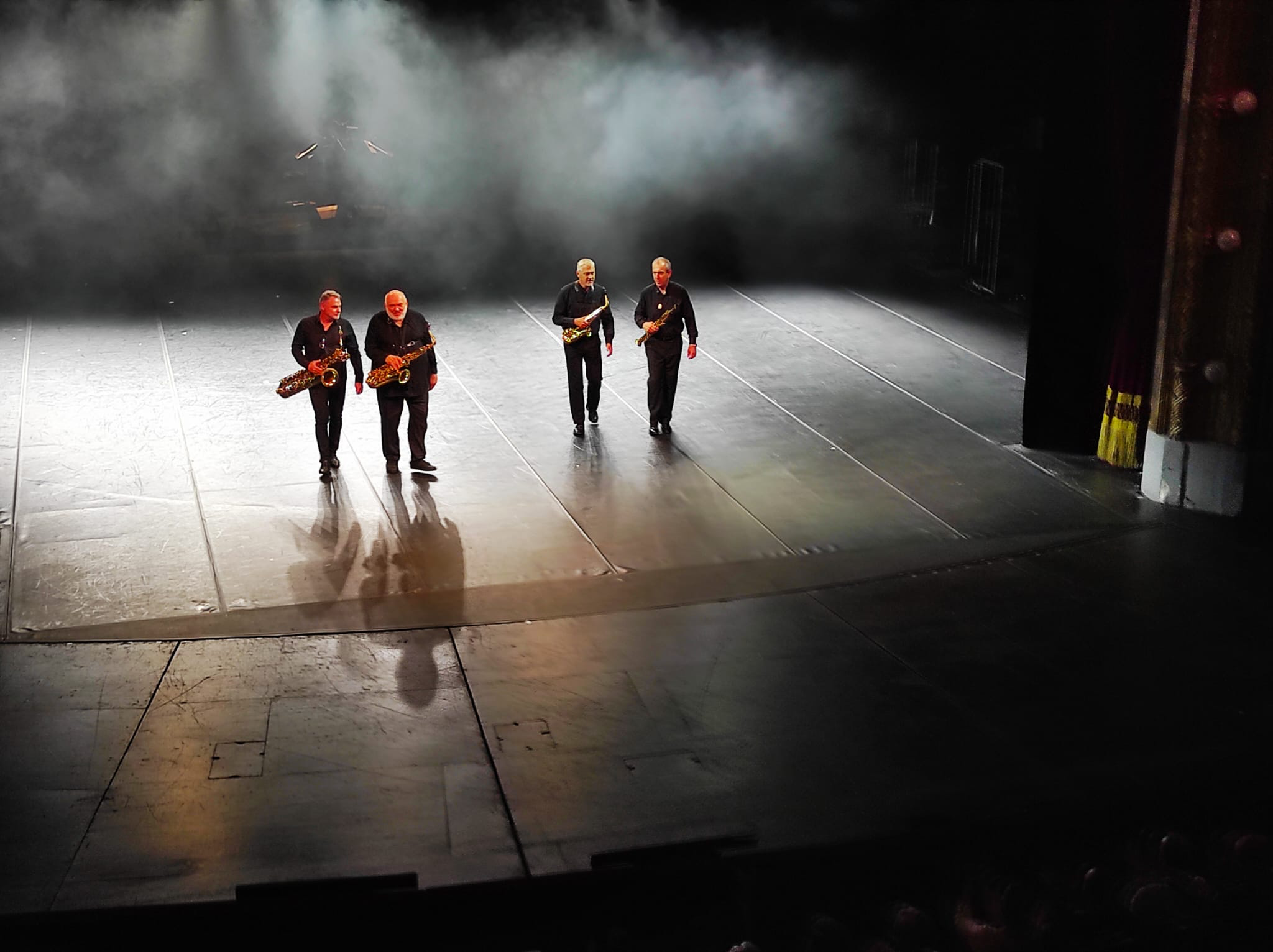
Since its founding in 1989, the Zagreb Saxophone Quartet has been composed of graduates of the Academy of Music of the University of Zagreb from the class of Professor Josip Nochta: DRAGAN SREMEC, soprano saxophonist, professor of saxophone at the Academy of Music of the University of Zagreb, GORAN MERČEP, alto saxophonist, professor of chamber music at the Academy of Music of the University of Zagreb, SAŠA NESTOROVIĆ, tenor saxophonist, professor of chamber music and jazz at the Academy of Music of the University of Zagreb, and MATJAŽ DREVENŠEK, baritone saxophonist, professor of saxophone at the Academy of Music and Vice-Rector for Arts of the University of Ljubljana.
Apart from Croatia, the quartet performed all over Europe and the world, in Albania, Austria, Argentina, Belgium, Bosnia and Herzegovina, Montenegro, Chile, Denmark, France, Greece, Italy, Canada, China (Hong Kong), Costa Rica, Latvia, Macedonia, Hungary, Monaco, Germany, Russia, Serbia, Slovenia, Spain, Switzerland, Turkey, Great Britain and the USA (Arizona, California, Connecticut, Georgia, Illinois, Indiana, Iowa, Louisiana, Massachusetts, Michigan, Minnesota, Nebraska, New York, North Carolina, North Dakota, Ohio, Pennsylvania, Texas, Utah, Washington DC, Wisconsin, Wyoming), in prestigious concert halls (Emerson Concert Hall in Atlanta, Hodgson Concert Hall in Athens, Hôtel de Ville in Brussels, Ny Carlsberg Glyptotek in Copenhagen, Knežev dvor in Dubrovnik, Palais des Nations in Geneva, Cankarjev dom and Hall of the Slovenian Philharmonic in Ljubljana, Círculo de Bellas Artes in Madrid, Ted Mann Hall in Minneapolis, Cathedral in Monte Carlo, Dvorana Tchaikovsky in Moscow, Max Joseph Saal in Munich, Weill Recital Hall at Carnegie Hall in New York, Theatre at the Canadian Museum of Civilization in Ottawa/Gatineau, Grand Palais in Paris, Richard Wagner House in Riga, The Younger Hall in St Andrews, Sala Victor de Sabata in Trieste, Palau de la Música in Valencia, Porgy & Bess Club and Eschenbach Saal in Vienna, Croatian Music Institute, Lisinski Hall and Bersa Hall in Zagreb, etc.).
As soloists and as members of quartets, they have performed with the Zagreb Philharmonic, the HRT Symphony Orchestra, the Zagreb Soloists, the Croatian Chamber Orchestra, the Varaždin Chamber Orchestra, the Slovenian Philharmonic, the Slovenian Radio and Television Orchestra, the HRT Jazz Orchestra, the Orchestra of the Armed Forces of the Republic of Croatia, the Croatian Navy Orchestra, the Orchestra of the French Guard, the Hong Kong Festival Wind Orchestra, the Emory University Wind Ensemble, the University of Minnesota Wind Orchestra, the Royal Northern College Wind Orchestra, and the San José Concert Wind Orchestra under the leadership of prominent conductors such as Pavle Dešpalj, Alun Francis, Nikša Bareza, Vjekoslav Šutej, Klaus Arp, Hans Graf, David Itkin, Marko Letonja, Kazushi Ono, Clark Rundell, and others.
Guest soloists at the Quartet's concerts were Tomislav Mužek, Itamar Golan, Lydia Artymiw, David Gazarov, Daniel Detoni, Pavao Mašić, Tomaž Sevšek Šramel, Slovenian Brass Quintet, Papandopulo Quartet, Quartetto Academia, Miljenko Prohaska, Ivana Kuljerić, as well as saxophonists Claude Delangle, Vincent David, Philippe Geiss, Branford Marsalis, Steven Mauk, Debra Richtemeyer, Eugene Rousseau, Kenneth Tse and others.
To the delight of the audience and critics, they performed at the Dubrovnik Summer Festival, the Split Summer, at the world congresses of saxophonists in Pesaro, Valencia, Montreal, Minneapolis, Ljubljana, St. Andrews and Zagreb, at the Zagreb Music Biennale, the Ljubljana Summer Festival, the Europhonia festivals in Zagreb, Musicora in Paris, Open Europe in Berlin, Europamusiale in Munich, at the Ohrid Summer, NOMUS in Novi Sad, World Music Days in Ljubljana, Postojna, Piran and Zagreb, Saxophonia in Riga, Trieste Prima, Julian Rachlin and Friends in Dubrovnik.
For their contributions to culture, the quartet has been awarded the Milka Trnina, Judita and Vatroslav Lisinski awards. The Zagreb Saxophone Quartet's performances have been included on fifteen different CD releases, for which the ensemble has been awarded seven Porin discography awards.
The repertoire of the Zagreb Saxophone Quartet includes numerous original compositions written for saxophone quartet, as well as transcriptions and arrangements of works from various musical periods, from the Baroque to the 21st century.
The Quartet's superb performances have inspired numerous Croatian (B. Bjelinski, D. Detoni, V. Čop, S. Foretić, N. Gläss, S. Glojnarić, S. Horvat, O. Jelaska, A. Klobučar, I. Kuljerić, B. Lazarin, S. Majurec, V. Nježić, N. Njirić, B. Papandopulo, M. Prohaska, R. Radica, M. Ruždjak, T. Simović, B. Šipuš, Z. Ščekić, M. Tarbuk, T. Uhlik), Slovenian (J. Golob, J. Gregorc, L. Firšt, M. Lazar, I. Lunder, J. Matičič, P. Merkù, I. Petrić, P. Ramovš, P. Šavli) composers, as well as the New Zealander N. Hall and the Americans D. DeBoor Canfield and J. Irabagon, to dedicate more than sixty new works to it.
Johann Sebastian Bach (transcription by Kazushi Tochio): Italian Concerto BWV 971
Allegro
Walking
Presto
Gordan Tudor: Several miniatures
Sergei Prokofiev (transcription by Dragan Sremec): Romeo and Juliet, suite for saxophone quartet
Scene
Montagues and Capulets
Julija
Dance of the girls with lilies
Romeo and Juliet before parting
Berislav Šipuš: In the Garden of Your Love, for saxophone quartet
Phil Woods: Three Improvisations
Presto
Broadly, freely
Seesaw