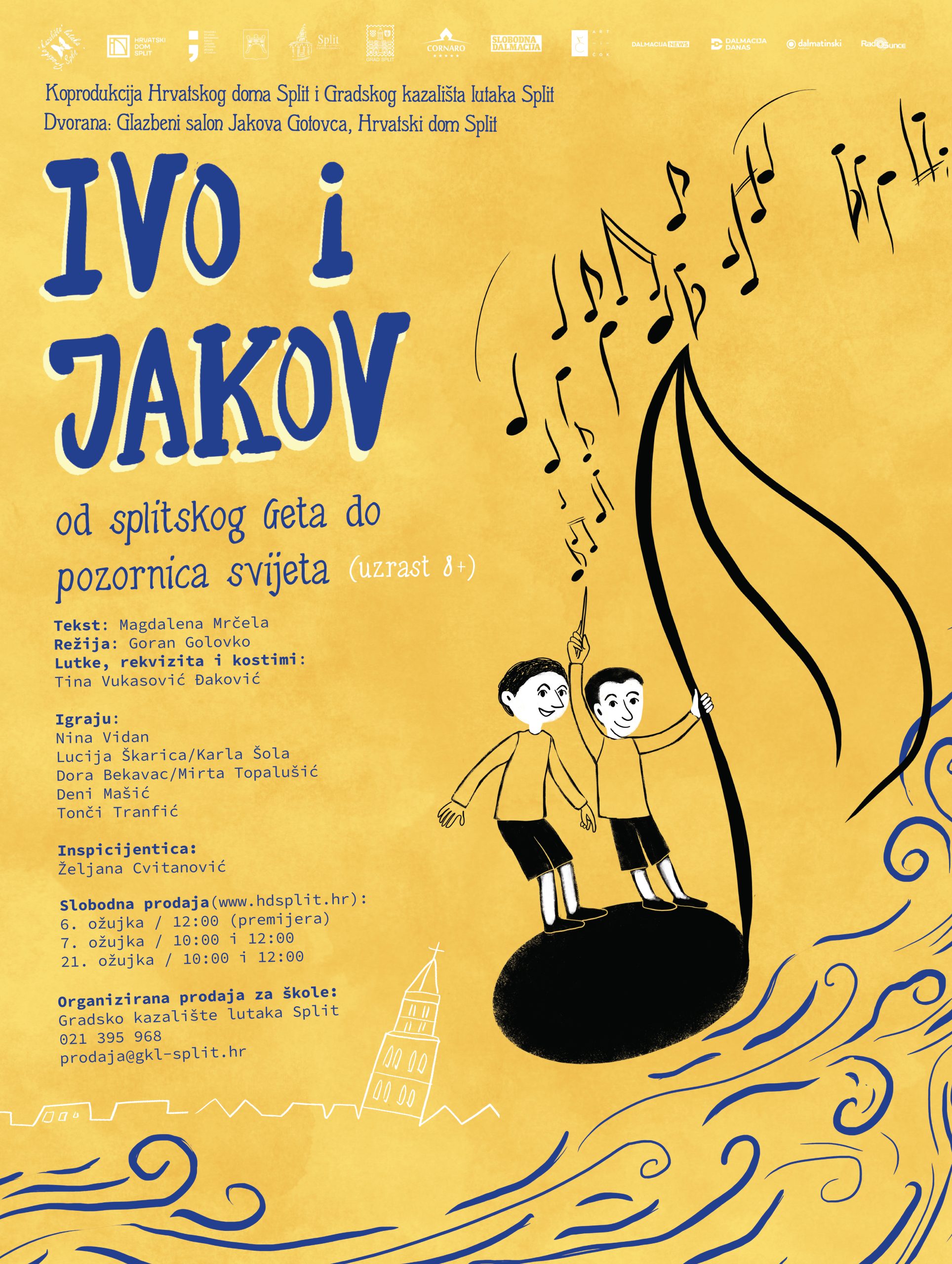

Both the greats Jakov Gotovac and Ivo Tijardović were once boys. They discovered the world through play in the heart of Split, they nourished their childish souls with its colors and sounds, they sang in the choir and discovered their love for music. Our performance will try to encourage young viewers to think about the nature of artistic creation and the choice of an artistic life path, it will introduce them to the most significant works of these two eternally playful boys and dreamers and give them the opportunity to create theatrical magic together with actors, a singer and a pianist. We want our young viewers to feel the joy of creating music and, perhaps, some of them to feel the call to their own journey into the world of creating beauty and nobility.
Goran Golovko
The starry journey of the two Split artists did not begin when they were already known as maestros Tijardović and Gotovac, in magnificent theaters and operas across Europe. That journey began with two playful boys, Ivo and Jakov, in the noisy streets of the Ghetto, playing in Đardin, exploring the Peristyle. Their creativity is marked by a childlike desire for music to always be their joy, fun and guiding thought. Keeping in mind that there may be a new Ivo and Jakov sitting in the audience at the Croatian Home and the City Puppet Theater, Goran Golovko places the great Split musicians in childhood – a space of purity, joy and play. Let us learn from them, let us dream with them, let us create new worlds in their honor!
Magdalena Mrčela
Jakov Gotovac and Ivo Tijardovic They were born in the same year, 1895, in Split. They grew up in the same streets and neighborhoods, shared school, their first musical attempts, and boyhood games. Their journey into music did not begin in large theaters, but in the everyday life of the city and the rich soundscape of Split from the late 19th and early 20th centuries.
During his high school days, Tijardović participated in organizing a tamburitza band in which Jakov Gotovac also played, which is confirmed by their early shared musical experiences. It is important to emphasize that pursuing a career in music was not a common or socially desirable life choice at that time. Gotovac's father openly opposed his musical interests, while Tijardović's family did not particularly encourage an artistic path. Despite such circumstances, both of them very early on showed a strong and abiding attraction to music, which would gradually grow into their life and professional commitment.
Although they started together, they formed two different artistic expressions very early on. Gotovac draws inspiration from the folklore and tradition of the Dalmatian hinterland, building a musical language of solid melody and clear form. Tijardović's expression is shaped by the urban culture of Split – theater, operetta, dance music and later jazz, which makes his music communicative, stage-lively and of a distinctly urban character.
Their relationship, which in their youth was marked by closeness and shared musical interests, was shaped over time primarily through professional encounters and parallel artistic paths. Later testimonies and interpretations of their relationship differ and sometimes point to tensions characteristic of the artistic environment, but there was mutual professional respect between them. As confirmation of the period of good relations, the fact that Jakov Gotovac conducted the first Zagreb performance of Tijardović's operetta is often emphasized. Little Floramye.
Through musical excerpts, the performance recalls the most famous works of both composers and the different aesthetic directions they took.
Ero from the other world (1935.) is the most famous and most performed operatic work by Jakov Gotovac. The opera evokes the folk music world of the Dalmatian hinterland, recognizable by its lively rhythms, singable melodies and strong choral expression, whereby Gotovac does not adopt specific folk tunes, but creates his own, stylized musical language inspired by tradition. The character of the young man Mićo, who disguises himself as a poor man in order to test Đula's feelings, is shaped as a witty, resourceful and somewhat cunning hero who sets the plot in motion with a series of deceptions, witticisms and stage twists.
Little Floramye (1926.) is one of the most popular Croatian operettas by Ivo Tijardović and a work strongly connected to the identity of Split. The operetta depicts Split society on the eve of World War I through a gallery of recognizable characters and humorous situations, but also through the lyrical love story of Floramya and Mirko. The central musical point of the operetta is the aria The pearl of the sea is far from me, a lyrical song of nostalgia and longing for one's hometown, which quickly became one of the most performed pieces in Tijardović's oeuvre.
Spli's watercolor (1928.) The second is a great operetta by Tijardović, permanently linked to the Split theatrical tradition. The work not only depicts the plot, but also the mentality of the city, its humor, speech and everyday life. The song Oh, little house is one of the most recognizable points of the operetta and symbolizes the strong connection of Tijardović's music with local identity and city memory.
Operetta Queen of the ball (1926.) belongs to Tijardović's works in which the influence of dance and popular music of the interwar period is clearly evident, especially the waltz, foxtrot and then popular dance songs. The work is thematically connected to football and Split's sporting life, which is no coincidence: Tijardović was a passionate fan of Hajduk and the author of the first draft of the club's coat of arms. Queen of the ball, a unique operetta dedicated to Hajduk, premiered in 1926 on the occasion of the club's 15th anniversary, making Hajduk the only football club in the world with its own operetta. Numbers like Songs of the outlaw and song That's not a dumpling., along with comic situations based on linguistic misunderstandings, build the cheerful and stage-playful character of the operetta.
Gotovac's musical and stage play Necklace (1955.), inspired by the works of Dinko Šimunović, continues the composer's interest in folklore-inspired stage stories. The work is like a more chamber and accessible version of his most famous operatic success, which is why it was already called "little Era" at the time of its creation. The plot, set in the Cetina region, follows the motif of the kidnapping of a girl and the triumph of love. Aria My necklace He particularly emphasizes the lyrical and melodic aspects of Gotovac's writing.
Musical drama Milo Gojsalić (1951.) represents Gotovac's attempt to create a more serious historical-national stage work. The plot tells the story of the legendary heroine of the Poljica Republic who sacrifices her own life to save the people, and in this work the composer strives for a stronger connection between music and dramatic action and a more monumental stage expression than in his earlier works. Among the most famous fragments stands out the mezzo-soprano aria Ode to the Earth, one of the most performed arias from Croatian opera literature.
A performance Ivo and Jakov – from the Split ghetto to the world stage The composer's life stories are shaped through scenes in which biographical and artistic layers are gradually revealed through experience, encounters and theatrical play. Instead of emphasizing great historical and biographical moments, the play focuses attention on the processes of the emergence of artistic identity and the circumstances from which such paths grow. The city is not only the backdrop to the action, but also a participant in artistic maturation. Split thus appears as an environment that shapes artists, but also as a space that we still pass through today, often unaware of how many different creative paths have already been formed in it. The value of such traces often becomes visible only when we view them from a temporal distance, and this play opens up space for such a new reading of the city and its cultural memory.
Text: Magdalena Mrčela
Directed by: Goran Golovko
Puppets, props and costumes: Tina Vukasović Đaković
Played by:
Stage manager: Željana Cvitanović
Co-production of the Croatian Home Split and the City Puppet Theater Split
Sales and reservations (organized sales): Split City Puppet Theatre / 021 395 968 / prodaja@gkl-split.hr
Sales (free sale): Croatian House Split / www.hdsplit.hr
Hall: Jakov Gotovac Music Salon, Croatian House Split
Free sale: