"I couldn't compose for almost a whole year...after that it was as if I had to learn from the beginning. It was like a rediscovery and seemed to me more beautiful than ever!” So wrote Claude Debussy (1862-1818) to the conductor Bernard Molinari in October 1915. The accumulated feelings came out in one of his last works, the Sonata for Cello and Piano , created in 1915. The composition was created after a year of compositional silence, which Debussy spent facing a serious illness and his own mortality. In it, Debussy flirts both with jazz and the Spanish atmosphere, as well as with experimental techniques of composing for the cello. It was the first of the planned six sonatas for different instruments (he managed to complete only three) that he decided to write in the footsteps of the French baroque tradition, especially Rameau, whose works he edited for a contemporary edition. In the Sonata for cello and piano, despite the modernist colors, textures and harmony, it sticks to the framework of the classical sonata form. The beginning of the first movement is written in the manner of a French overture, while the second theme is pentatonic. In the development part, both ideas are varied, and a short cadenza for cello also appears. The serenade brings a nocturnal atmosphere, filled with chromaticism and the mysterious pizzicato movement of the cello, which is in dialogue with the sharp chords on the piano. Spanish exoticism is most audible in the last movement, the passion of which grows in nervous bursts, while in the cello section different ways of articulation are alternated, in order not to realize the full potential of the ferocity that swells towards the end of the composition.
A master of melody, whose oeuvre consists of around six hundred songs, Franz Schubert (1797-1828) is one of the first true musical romantics, more inclined to smaller, more intimate forms of chamber music than to exposed concert genres. In his short life, Schubert composed a huge number of wonderfully diverse works dominated by a unique combination of the composer's cheerful nature mixed with a touch of melancholy and a sense of the tragedy of the approaching end. Widely recognized only after his death, Schubert presented his works to a relatively small circle of admirers of his music, living on the edge of poverty. In response to the failure with the opera Alfonso i Estrella, in 1824 he composed his Sonata for arpeggione and piano in A minor, a work dedicated to his friend Vincenzo Schuster, the inventor of a new instrument, the arpeggione. The most powerful testimony about this hybrid of six-string guitar and cello, which was only popular for a short time, remains precisely in this sonata, which today is mainly performed on the cello. The first movement brings a mixture of sadness and happiness, in which the lyrical first theme meets the carefreeness of the second theme, intertwining in the development part and at the end of the movement returning to the sad exhalations of the first theme. The second movement is shaped like a song, with a gentle flow set in E major, whose darker notes are encountered in modulations through third connections and chromatics, which at the end of the movement remind again of exhalations similar to those from the first movement. From the sad end of the second movement, the cheerful first theme of the rondo emerges. After the change of several dance melodies, the end is marked by an arpeggio, as the seal of this unique sonata in the cello literature.
Sonata for cello and piano is a harbinger for Dmitri Shostakovich (1906-1975) of the new aesthetic direction he will turn to, at a time when art in the Soviet Union is increasingly coming under the magnifying glass of the Stalinist regime. Called out because of the so-called formalism, i.e. composing that is incomprehensible to the people, Shostakovich, even before he was publicly accused in 1936 in Moscow's Pravda of "confusion instead of music", saw that the freedom of creativity and the direction he was taking, in the footsteps of the Western avant-garde, was not desirable. His upswing in his career will be abruptly cut short in 1936, but even before that, as one of the central figures of the music of the Soviet Union and always under the watchful eye of the Association of Proletarian Musicians, Shostakovich was carefully balancing on the edge of the permissible. Turning to classical models, in which he will "smuggle" his advanced musical thinking, will be one way to break through the darkness of the regime's music policy. His Cello Sonata is not yet quite the fruit of such a way of thinking, because the era of Stalin's terror had just begun, but it is one of the works conditioned by politics: with it, he, as a leading Soviet composer, was supposed to show others the way to compose chamber music. In it, he follows Beethoven's model: in the first movement, he brings a classic sonata form with two strongly contrasting themes. Shostakovich was separated from his wife at the time he composed the Sonata in 1934
Nine, in love with a young student he meets in Leningrad, who is thought to have inspired the lyrical second theme of the movement. The second movement, a dynamic scherzo, is satirical, while the cantilena movement Largo hints at his later style, stripped down and gloomy. The last rondo-style movement brings back the energy, more mechanical than truly vital.
José Bragato (1915-1917) is an Argentine cellist and composer born in Italy. He spent his career as the principal cellist of the Buenos Aires Philharmonic and then of the Teatra Colón orchestra in Buenos Aires. He led a parallel musical career, playing throughout his life in various jazz and tango orchestras, and Astor Piazzolla's ensembles, which creates Nuevo tango, a colorful musical world that, with its wealth of themes and emotions, crosses genre boundaries into the realm of serious music. There are a number of Bragato's compositions that are part of the permanent repertoire, among them the tango Graciela y Buenos Aires, originally composed for cello and string orchestra in 1994, as well as Milontán composed in 1983. In these compositions, Bragato explores the deeply lyrical expressive possibilities of the cello, combining witty way and with a lot of passion the classical tradition and heritage of tango.
Zrinka Matić
***
German pianist Andreas Frölich studied piano with Vitali Margulis at the University of Music in Freiburg and with Pavel Gililov at the University of Music in Cologne. Having won prizes at a number of competitions, he performs on the main stages in Europe, South America, South Africa, Japan and Australia, as well as at the Rheingau Musik, Schleswig-Holstein, Salzburg Easter Festival, Mozart Festival in Würzburg, Schubertiade in Roskilde and others.
He performed as a soloist with numerous renowned orchestras such as the Vienna Chamber Philharmonic, the Stuttgart Chamber Orchestra, the Munich Chamber Orchestra, the Beethoven Orchestra from Bonn, the St. Petersburg Philharmonic Orchestra, the Armenian Philharmonic, the Salzburg Chamber Soloists and many others.
One of the focuses of his artistic activity is chamber music. Frölich has performed with Ensemble Wien, among others, and is currently one of the members of the renowned Trio Mendelsohn from Berlin. He recorded more than thirty CDs, some of which won awards, for publishers such as CPO, EMI, BMG and others.
Since 2006, Frölich has been teaching at the College of Music and Dance in Cologne and Aachen. He is one of the co-founders and artistic directors of the Festival i AmadèO in Aachen and the MozARTe piano competition there, and the director of the Euriade Festival.
He regularly holds international master classes. He is a visiting professor at the Mozarteum Summer Academy in Salzburg. He is a member of the jury at numerous international piano competitions.
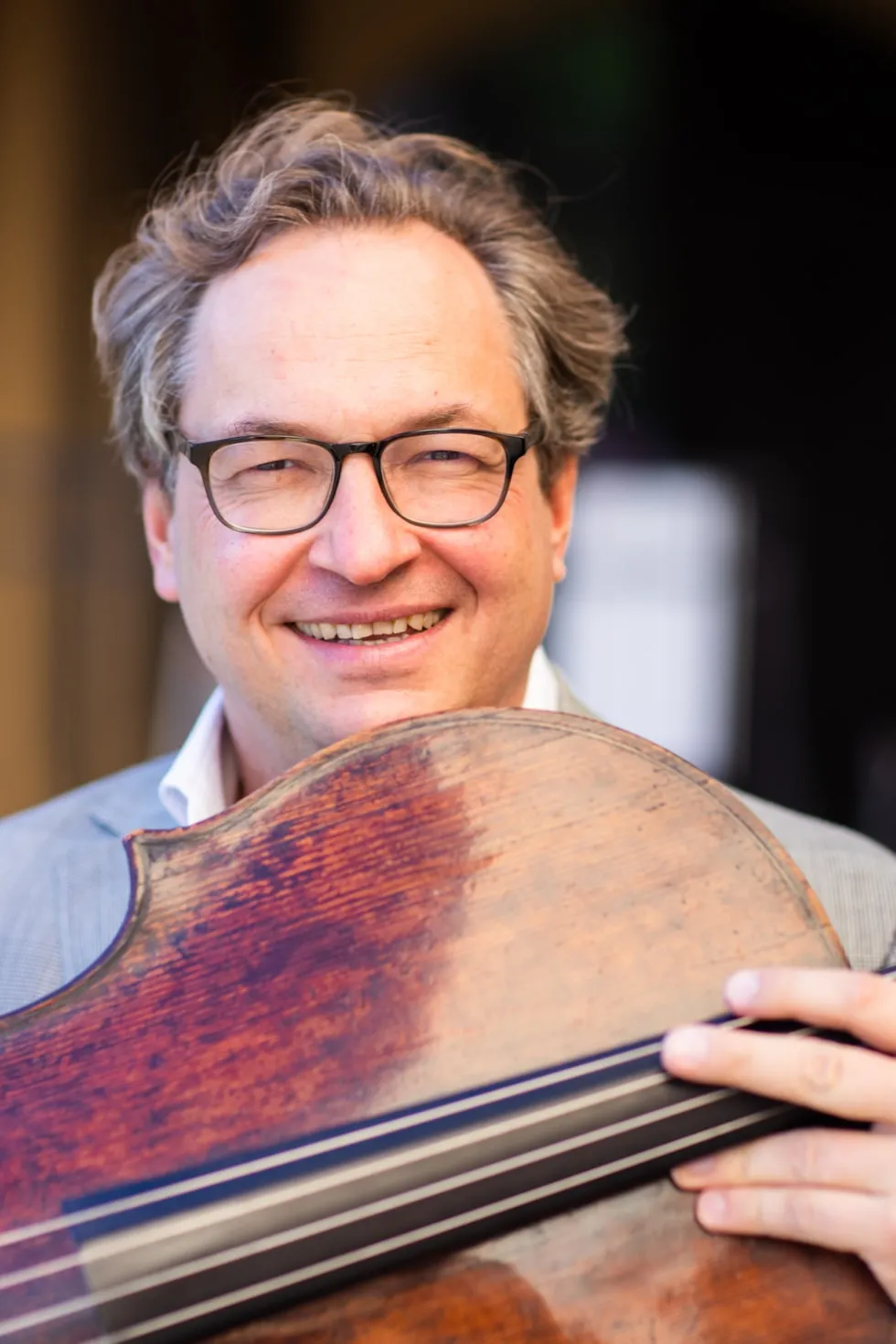
German cellist Alexander Hülshoff has established himself as a soloist and chamber musician on concert stages around the world. He stands out for his great expressiveness and strong, warm and nuanced sound, which makes his playing recognizable.
He performs as a soloist all over the world, with orchestras such as the German Radio Philharmonic, the German State Philharmonic, the Rhine Philharmonic, the Brno Philharmonic, the Cordoba Symphony Orchestra, the Northwest German Philharmonic, the George Enescu Philharmonic, the Rome Symphony Orchestra, etc.
Chamber music is at the center of his interests. He plays with colleagues including Pinchas Zukerman, Martin Stadfeld, Fazil Say, Hagai Shaham, Vadim Gluzman, Fine Arts Quartet, Orion Quarett, performing in halls such as the Berlin Philharmonic, Konzerthaus Berlin, Liederhalle Stuttgart, Laeiszhalle Hamburg, Concertgebouw Amsterdam, Wigmore Hall in London, Herkulessaal in Munich, etc.
Alexander Hülshoff is the founder and artistic director of the Kloster Kamp Chamber Music Festival and the artistic director of Villa Musica, a foundation of the state of Rhineland-Palatinate.
Numerous CDs with works by Brahms, Beethoven, Schubert, Shostakovich, Bloch, Servais and others testify to the breadth of his musical range.