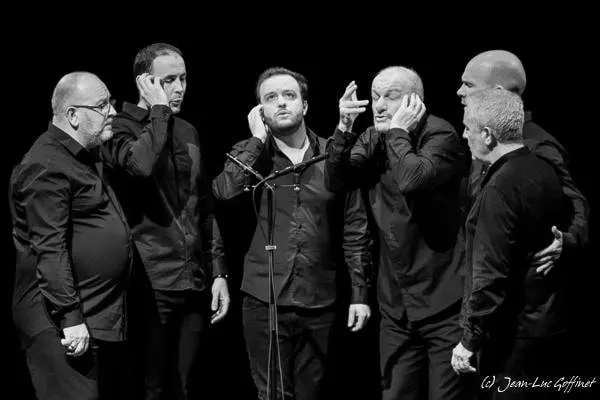
ABOUT MUSICIANS
The music of A Filetta is a journey... One could say that their music is like a polyphonic vocal proposal, a call, which is challenging, bold and contemporary, and is born from a powerful oral tradition.
In 1978, in the small Corsican town of Balagne, several very young people - including teenagers, started their journey, determined to contribute to the preservation of the then threatened oral tradition... And their journey was long, sometimes winding but always marked by discoveries and miraculous encounters. Therefore, the singers will gladly admit that the "meeting" is written into their musical DNA. This is exactly why they never wanted to limit that path only to the borders of their own roots: although they grew from the land of Corsica, just like the fern with which they identified - Corsican and fillet - and with which they symbolically described their way of singing, the singers of this group very quickly opened up to others - other climates, other disciplines, other artists (performers, composers, directors, choreographers).
The repertoire that this vocal sextet cultivates today is a faithful reflection of what has been their "walk forward" since the beginning of the 1980s: a path that gave an outline to a movement conceived from the oral tradition, which is confirmed by the twists and turns of its own creativity, without complexes and freed from any filial duty. Sacred music on their programs is found together with secular songs of various influences, film scores created with Bruno Coulais, music for Sidi Larbi Cherkaoui's choreography, as well as choirs for ancient tragedies or a requiem commissioned by the Festival in Saint-Denis.
The music of the A Filetta ensemble is dedicated to a vision of a world where identity is not something closed; their philosophy is encapsulated in the words of the poet René Char's beautiful aphorism: "The purest harvests are reaped on soil that does not exist; they are freed from gratitude and owe only spring."
To this day, A Filetta publishes a series of programmatically profiled and thematically unified albums, which are also the backbone of their concert programs. One of the most important projects, which is also related to the promotion and preservation of the once endangered oral tradition of Corsican polyphony, is the program Pulifunie, Canti e soni di Corsica, released during the 80s of the last century on five albums. Album Ab eternal from 1992 is the first on which the emphasis is placed on the sacred and secular original compositions of the ensemble members. Album Una tarra ci hé, published in 1994, contains a number of arrangements with instrumental accompaniment, whose lyrics evoke the history and beliefs and patriotism of Corsica, and was awarded the prize Grand Prix Académie Charles Cros. Album Passion brings together various original compositions, primarily by Jean-Claude Acquaviva, with the theme of Christ's passion, which the ensemble performed in Calvi since the beginning of the 90s. This album won the most important French discography awards: Le Choc du Monde de la Musique i Le Diapason d'Or. Songs on the album Intanta cover the period of the ensemble from 1994-2002. year, describing that part of their creativity dedicated to theater, film music (with Bruno Coulais), and collaboration with different artists from Sardinia, Georgia and Bulgaria. In addition to this, there is also an album completely dedicated to the music written for the band by Bruno Coulais, Si di me, including Medea with music for the theater play of the same name based on Seneca's model, are albums whose music relies on the vocal tradition of Corsica. Marriedà - translated as "mature colors", is the title of another award-winning album with fourteen previously unreleased songs, among which Way of the cross originated in Calvi. On the album Mistico Mediterraneo traditional expression merges with experimental, in a series of compositions by the founder of the ensemble Jean-Claude Acquaviva, and the album features trumpeter Paolo Fresu and bandoneonist Daniele di Bonaventura. Di Corsica riposu, Requiem pour deux regards, a program created in collaboration with bandoneonist Daniele di Bonaventura, is another backbone of the ensemble's repertoire; it is an interpretation of a requiem, i.e. a traditional Corsican one messa di i morti and the cult of the dead, which has a special importance in Corsica, again through the compositional vision of Jean-Claude Acquaviva.
The ensemble is a regular guest of the Theater in Bastija as well as various festivals, making original music for a number of performances (Oedipus roi based on Sophocles' text directed by Noël Casale, Ulysse sans terre Orlando Forios, Pessoasion directed by Helmut Bürgel, opera Lucio B. Coulais and O. Forios, etc.). He collaborated on a number of film scores (The Winged Migration 2001 by Jacques Perrin, music: B. Coulais, Comme un Aimant signed by Akhneton, music by B. Coulais and Akhneton, Le Liberton Jacques Weber, music: B. Coulais, Himalayas E. Vallija, music by B. Coulais, awarded the prize CÉSAR for Best Original Music, Don Juan J. Weber, with music by B. Coulais and others) A filetta founded the festival of Corsican polyphony in 1989, Recontres de chants polyphoniques in Calvi.
Until now, the ensemble has performed in some of the most important halls, theaters and church spaces around the world - Paris Salle Pleyel, Théâtre des Bouffes du Nord, Cité de la Musique, Cour Marly of the Louvre Museum, St Germain-des-Prés Church and others. ; in France: Opera in Lille, Arsenal in Metz, National Theater in Nice, at festivals in Montpellier, Aix-en-Provence, Saint-Denis, Europajazz, Jazz sous le Pommiers, etc. Outside of France, their performances take them to Théâtre de la Monnaie (Brussels), Bunkamura Theater (Tokyo), Belém Cultural Center (Lisboa), Jazz Festival in Bergamo, Gasteig Cultural Center (Munich), Konsert & Kongress (Uppsala), Brave Festival ( Wroclaw), Parco della Musica (Roma), Sadlers Wells Theater (London), Jazz Festival in Basel, Théâtre de la Ville in Luxembourg, Festival Grec (Barcelona), International Festival in Baalbeck, International Festival in Lebanon, Teatro Alfa (Sao Paulo), Barbican Center in London, International Art Festival in Perth (Australia), International Art Festival in Montreal, Ten Days on the Island festival (Tasmania), etc.
ABOUT MUSIC
Corsican polyphonic singing or polyfunie it fits into the wide climate of the folk and church-folk polyphony of the Mediterranean basin, which has spread in different close and distant variants in its different parts - from the coasts of Corsica and Sardinia, through the Dalmatian coast of Croatia, all the way to the Georgian coasts that mourn the Black Sea.
It has its roots, as well as other related traditions, presumably in ancient Gregorian melodies, revealing them in the still audible modality, compact interval shifts and gradual melodic inflection.
The oldest Corsican melodies are exactly like that, with a narrow range, untempered intervals, style patter, and what makes them recognizable is the strained production of the voice, to make it as loud and audible as possible when singing in the open spaces of the Corsican hilly interior, where this kind of singing developed among shepherds. Protracted long melodies in which sustained notes alternate with complex microtonal melismatic figures, called you're pulling, are the basis of polyphonic paghjella, the most recognizable form of the Corsican triad in which voices participate second, low i third. Paghjell characterizes gradual addition of voices, out-of-tempo intervals, of which the third interval is especially unstable and abundant decoration of the melody, and finally the typical ending on the Picardy third. While each village has its own specific variant or See her paghjelle, what is typical of all is the characteristic dissonance between the music and the text, where the breath is taken in the middle of the word, and sometimes the word is stretched over the main musical caesura. In order to be united, the members of the so-called team - always men - arrange themselves in a tight horseshoe formation, and often cover one ear with their palm. The performance is especially successful if the ethereal fourth voice appears, that is, the buzz of aliquot tones, which are the result of harmony, not only vocal but, as the singers believe, also spiritual. With paghjelle, as the most popular form of Corsican polyfunie, also occur terzetti i madrigals, and each village nurtured its own tradition of church singing, which was also transmitted orally. Church singing is similar to the triad paghjelle, and includes masses (messa di i vivi, messa di i morti), various hymns, processional songs and so-called praise, of which they are particularly good, thanks to numerous confrèries that is, church brotherhoods, those related to the rites of Holy Week have been preserved.
The program also belongs to this tradition, although most of the compositions are original Corsica' Amen, whose excerpts come from the thematic programs of the composition: Via Crucis in Calvi, Intanta, Di Corsica Riposu-Requiem pour deux regards, Passion, Marriedà i Castles.
L'orme sanguigne is a traditional song from Ruglianu, a devotional text in folk language that describes Christ's passion, which agrees in a way paghjelle, building from the unison of the first stanza to polyphony, with dramatic ups and downs in the words that describe Jesus' sufferings on the Way of the Cross. Densely polyphonic Kyrie exudes pungent harmonies that are born from untempered melismas, while Agnus dei di and defunti Jean-Claude Acquaviva composes in a typical manner missa di i morti, archaic sonorities, whose fifth consonances are reminiscent of the medieval polyphonic techniques of organum or falsobordone. Figliou d'ella (You who are her son are also my son) to text and music by J.-C. Acquavive is a poetic vision of spirituality that is present in every detail of nature and the universe since time immemorial, as the poem says, since time when the stories were created i miracles happened. Benedictus i Requiem - fragments of program units Via Crucis i Di Corsica Riposu, Requiem - take over the liturgical text, and the music is inspired by narrow intervals and meandering melismas that adorn traditional polyphony. Georgian Ghmerto (God) is a trip to the heritage of the related East-Mediterranean traditional polyphonic singing. In prayer, he turns to God for the protection of the Georgian people and help in defeating the enemy. Rex tremendae i Lachrymosa excerpts are again from the work Di Corsica Riposu – Requiem pour deux regards, created in 2004, based on a combination of the texts of the Latin Mass for the Dead and traditional texts, while the composition Blessed, in which J.-C. Acquaviva sets to music the Beatitudes from Christ's Sermon on the Mount, composed like a lively counter, part of the program Marriedà whose name the ensemble members explain as "the color of maturity". The composition is of epic character In Lamento di Maria, to a poetic text by Marcelo Acquaviva, with music by Jean-Claude Acquaviva, in which the leading voice leads through Maria's cry, and the others join him in a coloplet of lamenting, expressive ornamented lines, of which a particularly striking section is an imitation of the basic melismatic vocal line. Notte thin to the text of Petru Santucci, is a lullaby that in the central part reveals the modernist character of the song A Filette, when the previously connected polyphonic syllable is deconstructed in the manner of a medieval hoquetus. Father noster written in a declamatory style, it is filled with discreet decoration of homophonic syllables. A' l'alivet (In the olive grove) is a dramatic monologue, a recollection of a life's journey that boils down to the truth contained in the first words of the father, delivered in a strained part of the basic voice above the Bordun bass, which is followed by imitation like an echo, quietly in the interval of a fourth, creating an archaic, mystical atmosphere And syntenza (Judgment), In Sipolcr (Rough), Subtuum i In Lamento di Ghjesù (Lament of Jesus) is the spectacular final part of the program which, in the strong spectrum of Corsican polyphony, once again in the author's compositions of J.-C. Acquavive, R. Mambrini, T. Casalonge and N. Acquavive, pays tribute to the most important part of the musical heritage of Corsican polyphony, that dedicated to the Passion theme.
L'orme sanguigne (Way of the cross / Traditionnel de Ruglianu)
Kyrie Eleison (Intanta / Texte liturgique – Jean-Claude Acquaviva)
Agnus dei di i defunti (texte liturgique / Jean-Claude Acquaviva)
Figliolu d'ella (Di Corsica Riposu / Jean-Claude Acquaviva – Jean-Claude Acquaviva)
Benedict (Way of the cross / Texte liturgique – Jean-Claude Acquaviva)
Requiem (Di Corsica Riposu / Texte liturgique – Jean-Claude Acquaviva)
Ghmerto (Traditionnel - Géorgie)
Rex tremendae (Di Corsica Riposu / Texte liturgique – Jean-Claude Acquaviva)
Lacrymosa (Di Corsica Riposu / Texte liturgique – Jean-Claude Acquaviva)
Beati (Bracanà / Texte liturgique / Jean-Claude Acquaviva)
U lamento di Maria (Passione / Marcel Acquaviva – Jean-Claude Acquaviva)
Notte tana (Castles / Petru Santucci – Jean-Claude Acquaviva)
Pater Noster (Di Corsica Riposu / Texte liturgique – Jean-Claude Acquaviva)
A' l'alivetu (Passion / Jean-Claude Acquaviva – Jean-Claude Acquaviva)
A syntenza (Passion / Jean-Claude Acquaviva – Jean-Claude Acquaviva)
In Sipolcr (Passion / Jean-Claude Acquaviva – Jean-Claude Acquaviva)
Sub Tuum (Hello Regina / Texte liturgique – Jean-Claude Acquaviva)
In Lamento di Jesus (Passion / Rocco Mambrini - Toni Casalonga & Nando Acquaviva)