Marko Zupan - flute
Tommaso Lonquich - clarinet
Vlatka Peljhan - violin
Vid Veljak - cello
Petar Krokar - piano
Ivana Kuljerić Bilić - percussion
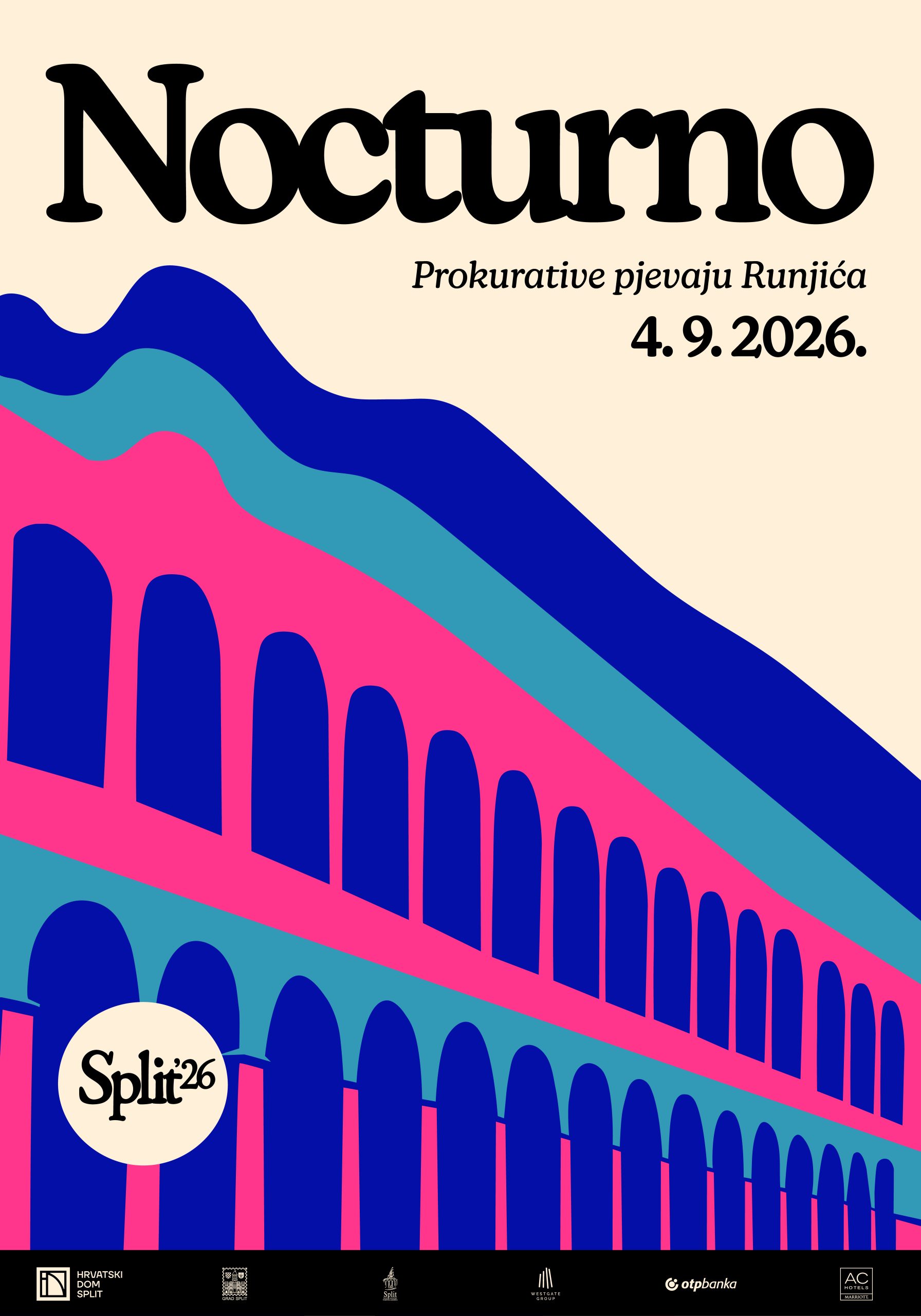
The musical past and present of Split meet at the beginning of the concert season in the Ivo Tijardović Concert Hall, in a "dedication to Split composers": great names of the past whose timelessness is proven with each new performance, Ivo Tijardović, Ivo Parac, Boris Papandopoulo (the composer, who, although not born in Split, spent some of his most fruitful years in this city, from which his masterpiece was born) The Passion of Our Lord Jesus Christ) of the Petar Bergamo, will meet the doyens of contemporary music from Split, Vlado Sunko, Ivan Božičević i With Olja Jelaska, as well as representatives of the youngest generation of Split composers, whose compositions have already taken root well in concert programs – Šimun Čarli Botica i Lukša V. Montana.
Time Ivo Tijardović (1895-1976) was still the time of small Split, but with a large theater, which in the times of change after World War I was waiting for a permanent Croatian opera and theater ensemble to be established there. The young composer spent some time in Vienna and Zagreb, working as an illustrator of sheet music publications and a cartoonist in newspapers, the so-called speck, returned to Split, just in time to realize his theatrical ambitions there. In the newly founded Split Opera, then the "National Theatre for Dalmatia", he presented his first operetta at the beginning of the first opera season of 1922/1923, Pierrot IloA few years later, two of his operetta pearls followed, Little Floramye 1926.i Split watercolor in 1928, in which he combines his various artistic talents, not only musical, but also literary, as a librettist, and scenic and visual as a set and costume designer. In these operettas he creates a kind of subgenre of operetta with a recognizably Mediterranean, Split color, adapting it, with its romantic and comic characters and light plot, to the city of Split, from which he selects and outlines a series of colorful, charming and witty types, a lively atmosphere and customs. The music is a flowing combination of inspired dances and Mediterranean cantilenas, some of the most beautiful of which echo in the prelude Split watercolor.
Mediterranean cantilena and temperament, although more restrained and completely differently colored than Tijardović's, also describe Ivo Parać (1890-1954), who returned to Split somewhat later, in 1925, having also spent his formative years outside Split and Croatia, completing his composition studies in Pesaro with renowned composers I. Pizzetti, D. Alaleone and L. Perosi. Parać felt the tectonic changes in 20th century music, accepting the legacy of Debussy as well as the modernist, expressionist coloring of the late romantic music of Italian composers of the early 20th century, remaining, like them, within the framework of tonality. In his works, composed with exceptional technical ease, we are imperceptibly, naturally drawn into the world of Art Nouveau atmospheres, dreamy gardens, and the poetry of Italian decadent poets such as Giovanni Pascoli. His Serenatella exudes such an atmosphere, he recognizes the other face of Dalmatia, instead of carnival and slush, evoking nostalgia for its ancient shallot.
A lasting mark on sensibility and musical language Boris Papandopoulos (1906-1991) The composer left Split in his younger days, when he worked as a choirmaster of the Split Singing Society. Zvonimir (1935-38), and later when he was the director of the Split Opera (1968-74). However, Boris Papandopulo was not a slave to just one influence, and his musical interests and inspirations reached out to various directions, not only to, for example, folklore, whether from Split, Dalmatia, Istria, Zagorje, etc., but much wider. His great opus, which ranges from solo and chamber music – for a wide variety of instruments and ensembles – to opera, ballet and symphony, often found inspiration in the performers themselves. This was the case until his late days, when, towards the end of his life, in the spring of 1991, he wrote his last work, Three items for Orlando, intended for the Orlando Trio, composed of renowned soloists: violinist Tonko Ninić, cellist Andrej Petrač, and pianist Vladimir Krpan. The work, intended for virtuosos, brings a complex flow of thought, with a series of smaller "footnotes", comments, reflections and digressions, which find their outlet in the soft flow of the middle movement, so that the conclusion is in the form of a complex, characteristic Papandopoulou game, in a moving dance rhythm. Since its premiere at the Dubrovnik Summer Festival in 1991, the composition has found a permanent place in the repertoire of a number of musicians.
Petar Bergamo (1930-2022) will only clearly reveal his deep connection with the Mediterranean and Split in some of his compositions, but it will more often be present only in the color or undulating playfulness of the chords, than in open melodic-harmonic statements, which he did not want to give vent to in his modernist oeuvre. In his work, he strove to give a new language to both instruments and voices, going into atonality and free musical forms, but freely using some classical compositional procedures.
Concerto abbreviate for clarinet from 1966, as its name suggests, is an abbreviated concerto for clarinet, in which – through the clarinet – Bergamo engages in a conversation, perhaps with himself, perhaps with the space, in which, in the pauses of the music, thoughts spoken and played echo in silence: the clarinet in his abbreviated concerto seems to be examining this space, which it occupies in the sound coordinates of height and depth, the width of the dynamics of the piano and forte, like a game in all directions, opening up this space little by little, connecting quiet questioning gestures into groups of tones, but then returning to the starting point again. Bergamo deliberately deprives himself of the clarinet's virtuoso heritage in the form of fast passages or fine cantilenas, and as if he puts the clarinet in a kind of state of amnesia, in which it must search anew for its language and its expression. This makes this concerto unusually attractive in a technical and musical sense, refreshing, because although not traditional, it is musical in a new way, with musical gestures resembling sentences and words that we understand well.
Composition Phoenix Vlade Sunko (1954), a composer, conductor and pedagogue from Split, was created as a result of reflecting on Ujević's poem The brotherhood of faces in space, which was the theme of the society's concert Splithesis 2010. In the composer's words, in this song Ujević "hints at the social crisis of our civilization, the crisis of morality, encouraging us to ask ourselves how to deliver man today from evil, from egoism, how to encourage the transformation of man into a truly religious man in the image and likeness of God?" Sunk's composition Phoenix it suggests that “we need to throw away old bad habits, burn away everything that distances us on the path to the spiritual brotherhood of people as the last word of evolution”. The music itself represents this path, from agitated rhythms that vary, representing “the discord of today’s world”, to polyphony that represents “the aspiration of the spirit” to the cataclysm, after which “particles connect, creating a new atmosphere, into which the piano part leads, supporting others towards a common goal”.
Composition Beyond the Bend in the Road Ivan Božičević (1961) is another piece on the program that finds inspiration in poetry – it is the poetry of Ferdinand Pessoa, who in this poem signs himself with one of his many pseudonyms, i.e. heteronyms as he himself called them, as Alberto Caeiro, wanting to emphasize that his heteronym functions as a separate author. The title poem, translated into English by Richard Zenith, deals with a single thought, examining it from different angles, about the secret that lies behind the "bend of the road". This thought – and the rejection of the idea of questioning this secret, and the acceptance of what is visible and present, is the impetus for the composer to embark on a musical exploration, which is based on repetitive techniques, which gain softness through the use of jazzy harmonic colors, giving Pessoa's thoughts a sense of fluidity and lightness. The composition is structured in two movements, originally composed for string quartet and piano. It was premiered by the Arthesis ensemble in 2023, and at tonight's concert it will experience its first performance in an arrangement for flute, clarinet, violin, cello and piano, adapted for the Synchronos ensemble.
Some of the most memorable compositions by the academic composer Jelaska oil (1967) are inspired by the extra-musical stimuli of the sea and marine motifs, in which she achieves a synesthesia of different sensations through her music, creating harmonies that bring to life the "blue wave", "amphorae", "seabed" and various other motifs. However, perhaps the greater part of her oeuvre stems from music itself and the stimuli she receives from musicians – often those who commission her compositions. Duo for flute and vibraphone was created in 1998 at the request of flutist Ana Domančić and percussionist Ivana Kuljerić Bilić. In the composition, according to the composer, "the theme of relationship emerged as the basic idea for the musical content. A relationship that can be interpreted as any relationship between two living beings, or even as a dialogue between different parts of the human psyche, such as consciousness and the underworld, for example. IT is a kind of imaginary dialogue without words, exclusively with musical material, attempts to create different forms of communication, agreement, disagreement, acceptance, rejection, etc." Since its premiere, the composition has been performed by various performers, and was also the impetus for the creation of a film in collaboration with composer and director Ivona Vladović in 2022 - it was a reverse process from the usual - instead of music for a film, a film was shot for music.
Impression of the landscape in the composition Distant Landscapes Šimuna Čarlija Botica (1997), by a young but already recognized and recognizable composer from Split, provides space for the creation of very open, wide sound contours at the beginning of the composition, filled with interwoven patterns of instrumental lines, which, according to the composer, "bring the atmosphere of a distant horizon. The sounds merge into outlines - recognizable, but obscured by fog. The thematic material remains abstract and fluid, as if taking shape before our ears, never quite graspable. The music creates a sense of movement towards something familiar, but still insufficiently discerned,
In the second movement, the contours become firmer, and the expression turns towards clarity and play. In a strong polymetric interweaving, a lively dialogue of the main thematic motifs develops, which contain reminiscences of the first movement." In a distant thought - as the composer hinted in the announcement accompanying the composition in 2022, when it was written for the S/UMAS ensemble, it is an image of an island - the composer compares the musical form and gradation to approaching an island - "from afar we see the contours of houses and forests and from experience we know by their characteristic form that they are precisely what we are talking about. But we see the content in its entirety only when we get completely close to that island".
At the heart of the inspiration for the composition Orbita a young composer Lukše V. Montana (2000) is "the cosmological idea of the "three-body problem" - a physical question about the unpredictable dynamics of the movement of three celestial bodies under mutual gravitational forces". The composer, who already has a number of works in the field of music for film, video and television, as well as an opus of solo, chamber and choral music, in this work transfers this idea from the field of physics into "musical space through three-thematic material in which the themes attract each other and form new sound images, creating the impression of floating, changing gravity." Although, as the composer says, the composition may sound impressionistic, in its background lies the dodecaphonic series - "not as a strict technique, but as a basis and source from which a diverse and dynamic sound whole develops". The composition Orbita, which is premiering at this concert, uses the musical material from the first movement of the Piano Quintet (2024) by Lukša V. Montana, which has already been performed many times.
Zrinka Matić
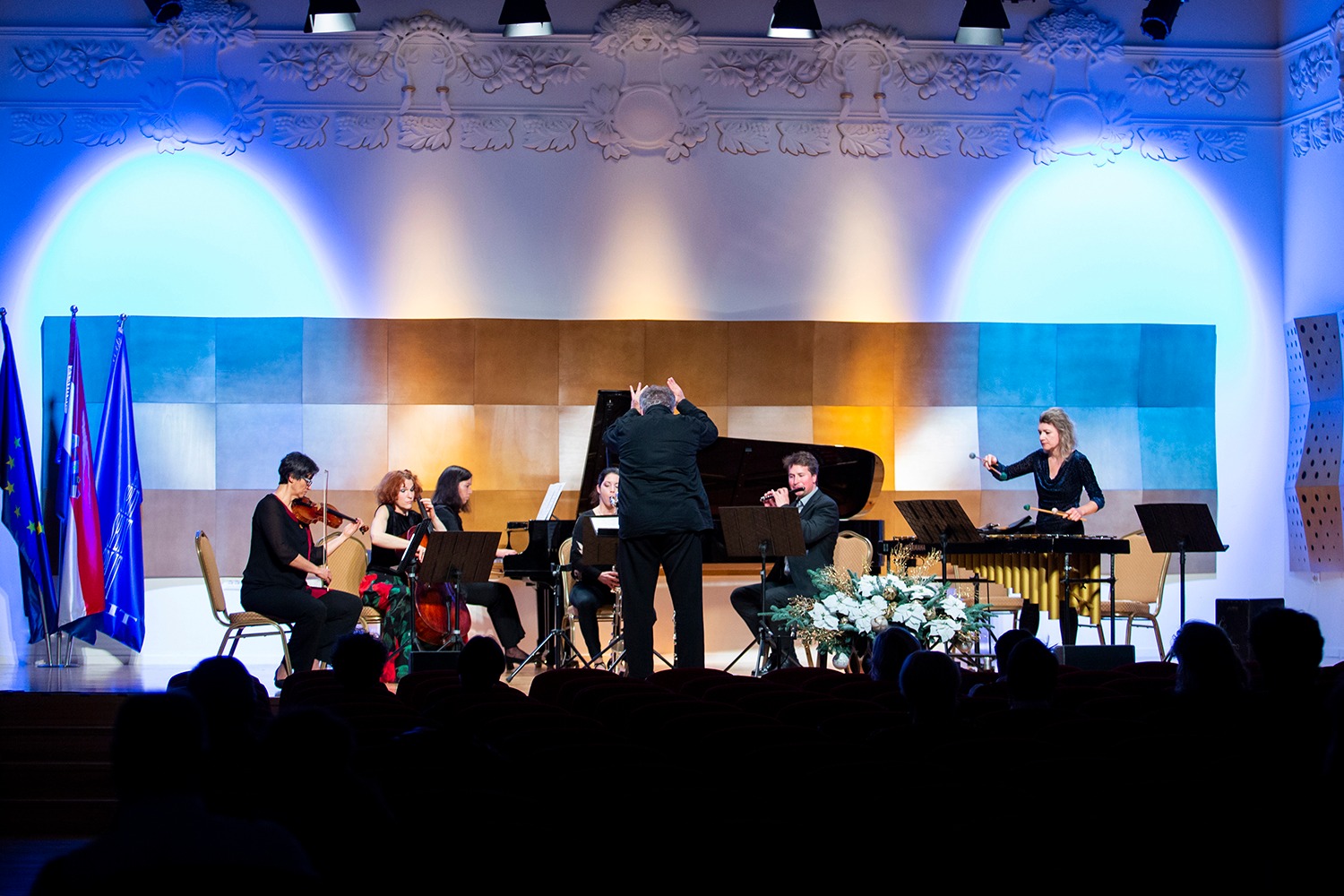
Ensemble Synchronos
The contemporary music ensemble Synchronos, based in Zagreb, is dedicated to performing current composers and generally refreshing the Croatian music scene, but also to introducing the audience to a more stylistically contemporary musical language. With their performances, the ensemble members move away from the already recognizable tonal influences of the postmodern period. Moreover, by choosing a specific repertoire, they participate in the creation of new compositions by living composers, and with their performances they shape conceptual patterns and overcome all the sonic challenges written in these scores. The ensemble insists on the idea of performing current, sometimes experimental contemporary music, in close cooperation with the composers themselves. Breaking the classical concept of listening to music is another vision of the Synchronos Ensemble, given that the Ensemble also performs music that does not correspond to the classical concept.
Since its inception, the ensemble has held a series of successful concerts, workshops and interactive lectures, both live and online, with the support of the Ministry of Culture and Media of the Republic of Croatia, the Croatian Composers' Association, the Academy of Arts and Culture in Osijek, the Austrian Cultural Forum, the Ernst von Siemens Foundation and others.
Among the numerous composers with whom the ensemble has collaborated and performed their works are Mladen Tarbuk, Andys Skordis, Marko Slaviček, Reiko Füting, Frano Đurović, Sanda Majurec, Tibor Szirovicza, Brigitta Muntendorf, Nina Šenk, Nico Muhly and Dubravko Detoni.
Ivo Tijardovic: Split Watercolor - Prelude (illustrated by Marko Zupan)
Ivo Parać: Serenatella for flute, violin, cello and piano
Boris Papandopulo: Three movements for Orlando
Petar Bergamo: Concerto abbreviato
Vlado Sunko: Phoenix
Ivan Božičević: Beyond the bend in the road, the first performance with new instrumentation
Olja Jelaska: Duo for flute and vibraphone
Šimun-Čarli Botica: Distant landscapes
Lukša V. Montana: Orbit, premiere