
Solist: Justus Grimm, cello
Conductor: Wladimir Kossyanenko
Split virtuosos
Born in Hamburg, Justus Grimm He began playing the cello at the age of five. He initially studied under his father, and later studied in Saarbrücken with Ulrich Voss and in Cologne with Claus Kanngiesser and Frans Helmerson. He supplemented his education with master classes with renowned cellists such as Steven Isserlis, Boris Pergamenschikow, William Pleeth and Heinrich Schiff.
Justus' talent has been confirmed by numerous awards at competitions — he won first prizes at the Maria Canals International Music Competition and the German Conservatory Cello Competition, and with pianist Florian Wiek he also won the Deutscher Musikrat competition.
As a soloist and chamber musician, Justus has performed extensively throughout Europe. He premiered Matthias Pintschern's cello concerto La Metamorfosi di Narciso with the Hamburg Philharmonic, and has performed with orchestras such as the English Chamber Orchestra, La Monnaie Symphony Orchestra, Royal Chamber Orchestra of Wallonia, Staatsorchester Rheinische Philharmonie, Brandenburg Philharmonic Orchestra, Sinfonieorchester Aachen and Klassische Philharmonie Bonn. His performances have taken him to prestigious stages around the world, including the Berlin Philharmonic, the Musikhalle in Hamburg, the Kölner Philharmonie, Munich's Herkulessaal, Brussels' Palais des Beaux-Arts and the Belém Cultural Centre in Lisbon.
In his rich chamber music career, Justus has collaborated with musicians such as Abdel Rahman El Bacha, Daniel Blumenthal, Gérard Caussé, Augustin Dumay, Benoît Fromanger, Philippe Graffin, Stephen Kovacevich, Katia and Marielle Labèque, Antonio Pappano and Florian Wiek. He has performed at festivals such as the Ludwigsburger Schlossfestspiele, the Festspiele Mecklenburg-Vorpommern, the Flanders Festival, the Dias da Música in Lisbon, the Festival Florilegio Salamanca and the Festival Consonances in St. Nazaire.
With pianist Florian Wiek he recorded the cello and piano sonatas of Beethoven, Brahms and Shostakovich for the Ars Musici label, and together with flutist Christina Fassbender he also recorded works by Weber, Farrenc and Mendelssohn. As a soloist he has frequently appeared on national radio stations in Germany, France and Belgium. In 2009 he released an album with the music of Philippe Gaubert in collaboration with the Fuga Libera label.
In 2011, Justus performed at the International Cantiere Festival in Montepulciano, where he was artist in residence. Since 2008, he has been teaching at the Antwerp Conservatory.
Wladimir Kossyanenko was born in Alma-Ata, where he began his musical education at the age of seven at the Kulyash Bayseitov Special Music School. He continued his studies at the Rimsky-Korsakov Conservatory in St. Petersburg, and then at the University of Music and Performing Arts in Vienna, where he received his master's degree with the highest marks. He studied with such distinguished pedagogues as Michael Kugel, Isaac Stern, and members of the Amadeus, LaSalle, and Alban Berg quartets.
He was a member of the Gustav Mahler Orchestra under Claudio Abbado, played with the Vienna State Opera and the Graz Philharmonic, and performed under conductors such as Solti, Maazel, Mutić, and Rattle. As a member of the Vienna Hugo Wolf String Quartet (1998–2007), he performed on the world's most important stages, including Carnegie Hall, the Concertgebouw, and the Vienna Musikverein. He has received numerous awards, including the European Chamber Music Prize (1999) and the Austrian Radio Pasticcio Prize (2003).
Kossjanenko has given more than 600 solo and chamber concerts around the world, recorded for the world's leading radio and television stations, and released ten CDs for reputable record labels. He has also performed as a conductor and premiered works by numerous contemporary composers.
As a soloist he has played with the Bavarian Chamber Philharmonic, the Zagreb Soloists, the Arthur Rubinstein Philharmonic, the Jerusalem Festival Orchestra, the Capella Luterana Vienna, the Vienna Academic Orchestra, and the Zadar and Split Chamber Orchestras. He has also collaborated with renowned international soloists: Bruno Canino, Filippo Gamba, Nicholas Angelich, Michael Kugel, Gerard Causse, Paul Meyer, Patricia Kopatchinskaja, Petrit Ceku, David Grimal, Alois Posch, Mihael Ursuleas, and with renowned ensembles such as the Altenberg-Trio Vienna, Ensemble Wiener Collage, Vienna Secession Players, Ensemble XX. Century Vienna, Trio Orlando Zagreb, Tartini Quartet Ljubljana, and Sebastian Quartet Zagreb.
Since 2008, he has been teaching viola and chamber music at the Academy of Arts, University of Split, where he has been a full professor and head of the Department of Strings and Guitar since 2022. He is the founder of the Student String Orchestra, the Days of JS Bach in Split festival, and the chamber orchestra Splitski Virtuosi, with which he has achieved numerous performances and awards, including the EFFE Remarkable Festival of Europe label. For his contribution to the cultural life of Split, he was awarded the Golden Gregory (2019).
He regularly collaborates as a guest viola leader with prominent European orchestras and teaches as a guest professor at the Music Academies in Zagreb and Sarajevo.
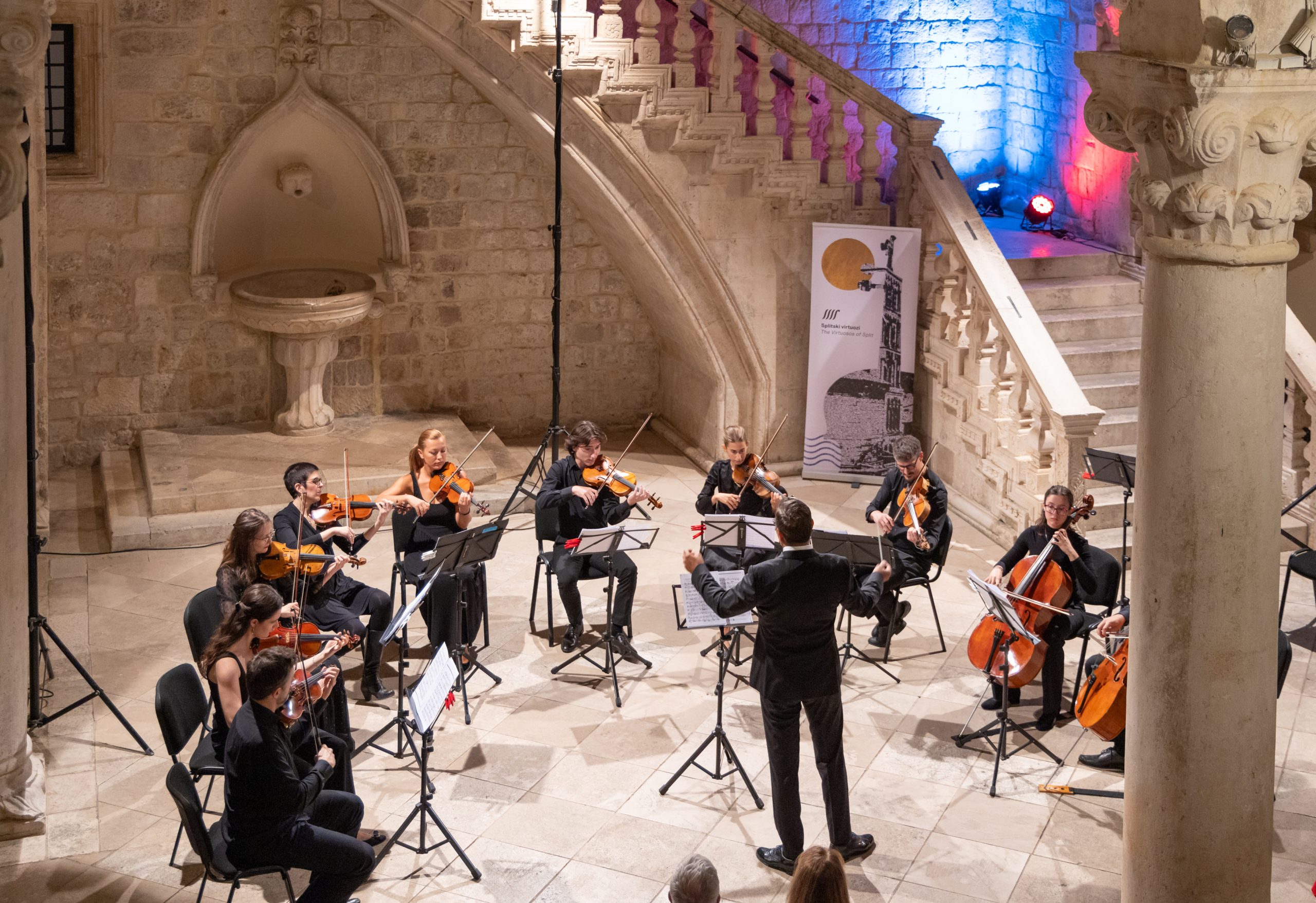
Split virtuosos are one of the leading Croatian chamber orchestras, founded in 2012 on the initiative of the Artemis Music and Arts Association, the Music Youth and the Music Department of the Academy of Arts of the University of Split. Under the leadership of violist and conductor Wladimir Kossjanenko, the ensemble brings together top professional musicians with many years of experience on domestic and international concert stages. From its first performances, the orchestra has attracted the attention of the audience and critics, confirming its status as one of the highest quality chamber ensembles in Croatia.
During their ten years of activity, the Split Virtuosi have held more than 60 concerts in more than 30 Croatian cities, including Zagreb, Split, Zadar, Dubrovnik, Hvar, Osijek, Pula, Šibenik and many others. Their performances have featured musicians from 19 countries, and the orchestra has collaborated with numerous prominent soloists and ensembles, including guitarists Zoran Dukić and Edin Karamazov, pianists Vesna Podrug, Lovro Marušić, Grigory Gruzman and Alexander Vitlin, violinists Mai Suzuki, Fritz Gearhart, Dragan Radosavljević and Arman Mourzagaliev, and cellists Kim Cook, Pauline and Felicitas Stephan. Of particular note is their collaboration with the American choir West Village Choral, which has further strengthened the ensemble's international reputation.
The orchestra is a regular presence at domestic and international festivals. In 2018, it represented Croatia at the Celloherbst am Hellweg in North Rhine-Westphalia (Germany), where the performances were met with enthusiastic audience and excellent reviews. Also notable were performances at the 60th Musical Evenings at St. Donatus in Zadar in 2020, and a charity concert in Zagreb in 2021 for the reconstruction of a building damaged in the earthquake.
Particularly notable were their performances as part of the Dalmatian Cycle: in 2022, they held concerts in Zadar, Split and Dubrovnik, ending the season with a gala concert at the Croatian House in Split in collaboration with Ukrainian soprano Olesya Tokarenko and pianist Lovre Marušić, while in 2023 they participated in the Second Dalmatian Cycle and held a tour of the Adriatic with concerts in Dubrovnik, Kaštela, Split, Zadar, Pula and Senj.
In addition to top-notch performances, the ensemble pays special attention to the education of young musicians through involvement in the preparation of concert programs, seminars and workshops. In this way, the Split Virtuosos not only foster a high musical standard, but also actively contribute to the development of a new generation of Croatian musicians, building continuity of musical excellence and professional development.
Recognizable for its neoclassical expression, singing melodies, rich rhythm and imaginative instrumentation, Bruno Bjelinski (1909 – 1992) created one of the largest and most important opuses of Croatian music of the 20th century, remaining one of the most performed Croatian composers even after his death. Although he composed in almost all musical genres, he devoted particular attention to concerto music, creating a series of works that combine virtuosity and expressiveness, technical complexity and direct communicativeness.
Concerto for Cello and Orchestra No. 1 It was composed in 1945 and premiered in 1946 at the Croatian Music Institute in Zagreb, performed by cellist Mirko Doner and the Zagreb Radio Symphony Orchestra conducted by Friedrich Zaun. The composer later revised it and published it in 1968 in Belgrade under the title Concerto for cello, strings and percussion, further honing the fine nuances of the orchestration, the agile wit of the solo section and the overall vibrant atmosphere of the work. Over the course of three movements, the solo cello role traverses a long and intriguing path composed of broad cantilena lines and technically demanding, brilliant, playful passages, revealing ranges from lyrical to dramatic, from classical to modern, from soft depths to sparkling heights.
First paragraph (Andante quasi recitativo – Allegro) begins with an exposition of the solo cello, followed by a fast section in classical sonata form, built on the contrast of dramatic and lyrical themes, filled with a series of dreamily enraptured digressions of the development section. The second movement (Slow) has a calm, meditative character, arising from two melodic lines shaped in ancient modes, which give the movement a distinctively dark color, intertwining in the cello solos and orchestral lines, in a long, tense arc, resolving in a soft, bright finale filled with tremolos and strong string unisons with characteristic timpani blows. The final movement (Very happy) is a pulsating whirlwind of themes in the form of a rondo, which exudes lively energy and rhythmic variety – the main theme first in the orchestra and then in the cello alternates with various contrasting episodes, leading to the work's sparkling sonic conclusion. This composition, imbued with lightness, elegance and technical sophistication, shows Bjelinski as a master of form and instrumentation and is a true masterpiece of the Croatian concertante repertoire of the 20th century.
One of the most important Croatian composers of the 20th century, Boris Papandopoulo (1906–1991), was also a conductor, choirmaster, accompanist, organizer, and music publicist. His oeuvre includes more than 500 compositions, which are distinguished by their mastery of the compositional craft, cheerfulness, enthusiasm, and humor, virtuoso treatment of instruments, and a distinctive synthesis of various styles and technical procedures of the 20th century.
Four Inventions for the Camerata (Vier Inventionen für die Camerata) belong to his late compositional period. They were composed 1985 for chamber orchestra Camerata musica BerlinThey were created in Tribunj, between June 2 and July 30, 1985, at the urging of Papandopulo's godfather and friend. Zeljko Straka, musician and founder of the aforementioned ensemble, composed of top soloists of the then German Democratic Republic. As in many of his works of neoclassical and neo-baroque idiom, Papandopulo in Four inventions uses the formal pattern of Baroque invention, filling it with a contemporary and original harmonic language. The work consists of four contrasting units of different character and tempo, in which the composer applies his recognizable procedures to motifs of typical Baroque rhythm. Written in the spirit of historically informed performance practice, these inventions require exceptional technical skill and a high level of mutual musical harmony from each member of the ensemble.
Composer, organist and pianist Ivan Božičević (1961), one of the most prominent contemporary musicians from Split, is recognized for his eclectic musical expression that combines different styles and genres. His works are often found in the repertoire of many musicians, and many have been awarded at international competitions. Božičević successfully combines elements of classical, jazz and pop music in his music, and his versatility is best reflected in his collaboration with musicians from various musical circles, which brings a new dimension to each project he works on. Composition Little clockwork train for strings was composed in 2022. "Coincidence wanted - as the author explains - that this composition (like Beyond the Bend, performed a month ago at the Croatian House in Split) would be inspired by the poetry of Fernando Pessoa." It is the last stanza of the most famous poem signed with his own name - AutopsychographyA little wind-up train, as the lyrics say, that entertains our thoughts – this is the image that inspired Božičević to compose a composition that “stylistically remains within my relatively usual repetitive-minimalist framework, with an emphasis on pulsating rhythm, intertwined patterns, jazzy harmonic language". What the composer highlights as unusual is the absence of the piano, which is most often the bearer of rhythm and repetitive figures. In this composition "everything is left to the strings". Verses by Pessoina Autopsychographs in which the poet – otherwise prone to presenting himself in heteronyms, who invented numerous alternative personalities of his own – describes poetry as a pretense, a falsification of even those feelings he truly feels, find an echo in Božičević's composition. For reasons of rhythm, the poet chose the lines of the last stanza (translated into English) as a stimulus, because of their rhythmic quality – a mechanical train that tirelessly spins on its tracks, entertaining our thoughts, can represent precisely this artificiality of the artistic act and the concealment of the true emotion within it.
Šimun Čarli Botica (1997) is one of the most present composers of the young generation on concert programs. His compositions have gained popularity in performances by prominent artists such as the Split Virtuosos, Duo Tudor&Režić, Guitar Duo Montenegrin, Thorwald Jørgensen, Kalamos Quintet, Mia Pečnik, Branimir Norac, Petar Čulić, Silvije Bilić and many others, gaining recognition already during his studies in pedagogy and then composition with Prof. Ivan Božičević at the Split UMAS. His new composition Thus the Moon Unfolds is dedicated to the Split virtuosos, and is a kind of impression for strings, which begins “in the weight of the night”, as the composer describes it – “in a space where sound seems to be stifled by darkness, like the air itself. From that silence, the moon rises, without warmth but spreading a silvery cold slowly and relentlessly. Its light does not bring comfort, but sharply outlines the silence, illuminating the void with its fragile light. The music reflects its presence: rays that remain far away. As the silver moonlight intensifies, a contrast appears – not between darkness and light, but peace and trembling movement. What is born is a tangible solitude: wide enough to cause anxiety, but beautiful in its stillness and coldness. In that tangible solitude, the moon is not a friend but a witness – distant, silent and unyieldingly present, illuminating the night with a pale light.”
Zrinka Matić
Bruno Bjelinski: Concerto for cello, timpani and strings
Boris Papandopoulo: Vier Inventionen für Camerata
Ivan: Božičević: Little Clockwork Train – premiere
Šimun-Čarli Botica: Thus the Moon Unfolds – premiere