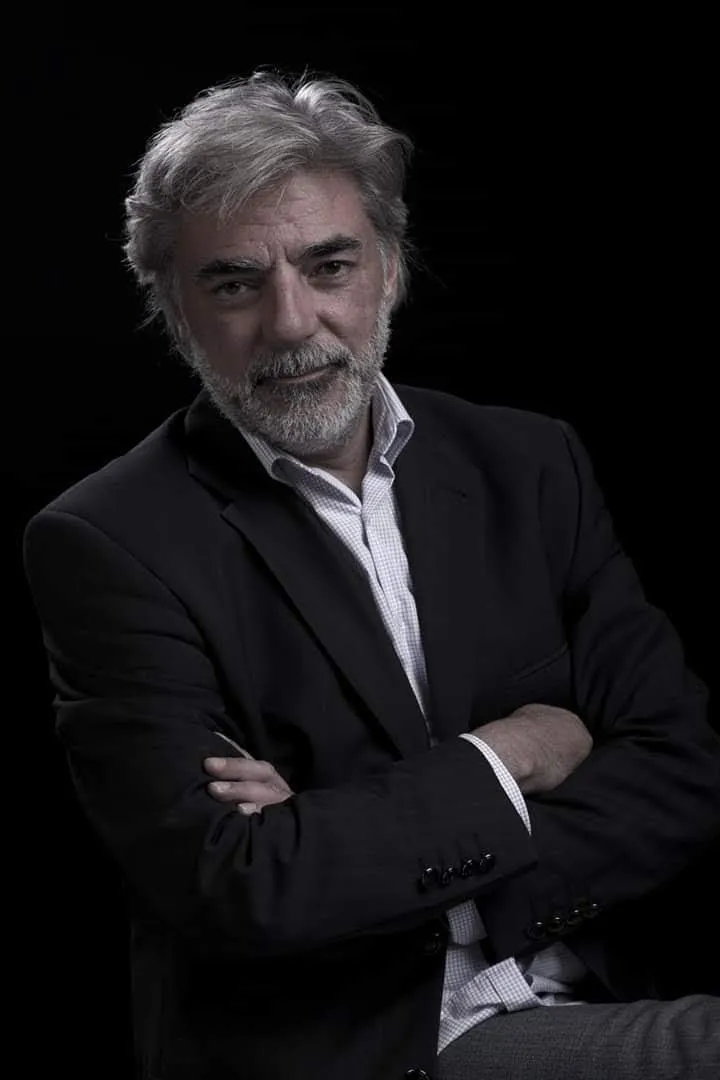


Winner of the prestigious British Composers' Award BASCA, multi-instrumentalist Andy Scott is a versatile contemporary musician with a distinctive saxophone and compositional approach that incorporates elements of jazz , world music and contemporary classical music. Scott works on commission, often for leading instrumentalists and ensembles on the world stage. He teaches in the composition and saxophone departments at the Royal Northern College of Music , is a popular course leader and gives lectures and workshops around the world. In addition to being a bandleader in his own groups and projects, Andy is regularly invited as a guest to lead and direct large groups and creative projects. For over thirty years he has been initiating creative collaborative projects, one of which is dedicated to the music of Moondog and his work "Bird's Lament" for Charlie Parker, which he realizes with the SAX-UMAS Ensemble.
An unconventional composer, poet, music theorist, musical instrument inventor, and performer, Moondog wrote "Bird's Lament" in 1955, after the death of saxophonist Charlie Parker, who went by the nickname Bird. He was friends with him in the early 1950s, when they often talked about music and the possibility of a collaboration that never came to fruition. This work, which represents his interest in jazz music in the 1950s, was recorded for the album "Moondog". The author conducted an orchestra of fifty musicians during the recording. This album significantly contributed to his reputation as a composer of serious music. Namely, Moondog then moved from jazz conventions to the sphere of classical music, first through third-wave music and minimalism. In fact, he showed a preference for classical music as early as the 1940s, when he became an honorary member of the New York Philharmonic at Carnegie Hall.
Largely self-taught, he drew inspiration for his work from jazz , classical, Latin American, and Native American music, which he was exposed to as a child. His rhythmic, contrapuntal works and arrangements later particularly influenced Frank Zappa and Igor Stravinsky, but also minimalist composers such as Steve Reich and Philip Glass, who valued this inspiration much more than what they were exposed to during their studies at Juilliard. He also influenced other artists, including Lenny Bruce, William S. Burroughs, and Allen Ginsberg, with whom he was friends. His compositions have been performed by prominent musicians of various genres, from Jimmy McGriff, Janis Joplin, Marc Bolan, Stefan Lakatos, and Jon Irabagon to Pink Martini, Katia Labeque, and the Kronos Quartet, some of whom composed works dedicated to Moondog himself.
As an innovative artist, Moondog invented a number of musical instruments that he played at concerts and album recordings, the most famous of which is the trimba, a triangular percussion instrument that he invented in the late 1940s.
Louis Hardin was a blind composer and musician who was born in 1916 in Kansas, the son of a minister. At the age of five, he began playing drums he made from cardboard boxes. Once, his father took him to the Arapaho Sun Dance, where he sat on Chief Yellow Calf's lap and played a tom-tom made of buffalo hide. He also played drums in the high school band. At the age of sixteen, he found an object in a meadow that he did not know was a dynamite cap, and as he examined it, the explosive detonated in his face, permanently blinding him. After the accident, his older sister Ruth read to him every day for years, and thanks to this, he became acquainted with the philosophy, science and myths that shaped his character, and the book "Jessie Fothergill's Violin" inspired him to start taking music more seriously. Until then, he had been interested mainly in percussion instruments, but from then on he became obsessed with the desire to become a composer. After learning musical principles at several schools for blind young men throughout Central America, he taught himself the art of ear training and composition.
In 1943, he moved to New York City, where he met classical musicians, including Leonard Bernstein and Arturo Toscanini, as well as jazz musicians such as Charlie Parker and Benny Goodman, whose upbeat tempo and humorous approach influenced his work. In 1947, he adopted the stage name Moondog. From the late 1940s to 1974, he was known as an eccentric figure in New York City street life. He is known for standing on street corners in New York City, selling and performing his music, which attracted the attention of journalists and musicians, and he made a series of recordings from 1949 to 1957. In 1949, he traveled to the Blackfoot Sun Dance in Idaho, where he performed on percussion and flute, returning to the Native American music he had first encountered as a child. It was this indigenous music, along with contemporary jazz and classical music, and the ambient sounds of his surroundings - city traffic, sirens, subway trains, ocean waves, human speech... - that formed the basis for Moondog's music. In the 1960s, he developed a distinctive image and worldview; he wore Viking-inspired garb, which earned him the nickname "The Sixth Avenue Viking". He promoted belief in the Norse gods so fervently that he set up an altar in his rural retreat in Candor. By the late 1960s, he was praising classicism and rejecting the belief that there was such a thing as originality.
Moondog won a case in the New York State Supreme Court in 1954 against DJ Alan Freed, who had named his radio show The Moondog Rock and Roll Matinee "Moondog" after a recording of "Moondog's Symphony" from the first record Moondog ever made. He believed he would not have won the case had it not been for the help of Benny Goodman and Arturo Toscanini, who testified that he was a serious composer. Freed was forced to apologize and stop using the name Moondog on the air, as Hardin was known by that name long before the host began using it. Moondog briefly visited the United States again in 1989 for a tribute at the New Music America Festival in Brooklyn, where festival director Yale Evelev asked him to conduct the Brooklyn Philharmonic Chamber Orchestra, sparking renewed interest in his music.
Moondog died in 1999 in Germany, where he spent more than two decades of his life after leaving the US in the mid-1970s.
A review written by Andy Scott himself
"During the 1990s I had the privilege of playing in an ensemble called London Saxophonic (led by Gareth Brady and Will Gregory). Ten saxophones, along with piano, bass guitar and percussion, embarked on a musical journey with Louis Hardin, better known as Moondog!
For most of that decade, as young saxophonists we flew around Europe almost every week, playing festivals, warehouses and concert halls. Radio shows and the recording of two albums followed. As my colleague, the percussionist Paul Clarvis, said in 1994: "This work will gain importance over time." And here we are in 2024, in beautiful Split, where we present to you some of the works that London Saxophonic and Moondog performed and recorded during the 1990s.
I was in charge of guiding Moondog to stage position (he lost his sight as a teenager). He would always wear a Viking helmet and a long cloak, and was adorned with a distinctive long white beard. He would sit behind his bass drum, maintaining a constant beat throughout the performance. Sometimes he would get up from behind the drum, crouch down and start playing his favorite 5/4 beat – on the floor!
Moondog wrote in Braille, and after leaving us in 1999, his music is now owned and distributed by Alexander Duve in Berlin. I am extremely grateful to Alexander for allowing us to use that music for this special occasion.
I am also grateful to the exceptional musician Gordan Tudor. Gordan organized all this, and thanks to his students in Split (Sax Umas) and professional colleagues, today we can present you some music from the genius mind of Moondog.
At the end of this concert, we will perform three short pieces that I personally composed and/or arranged. My life is divided between composing music and playing the saxophone, and it's a real privilege to travel and share music with amazing musicians all over the world!"
Discounts apply! More information about sales and discounts in the 2024/2025 season can be found here.
Music by Moondog:
Dog Trot
Shakespeare City
Novelties 1, 2 & 3
Sandalwood
Single Foot
Fiesta (solo piano)
Sea Horse (solo piano)
Present for the Prez
Hymn to Peace
EEC Lied
Mother's Whistler
Bird's Lament
Paris
Golden Fleece
Music by Andy Scott:
The Golden Horn
The Water Is Wide
Inspiration