Menu
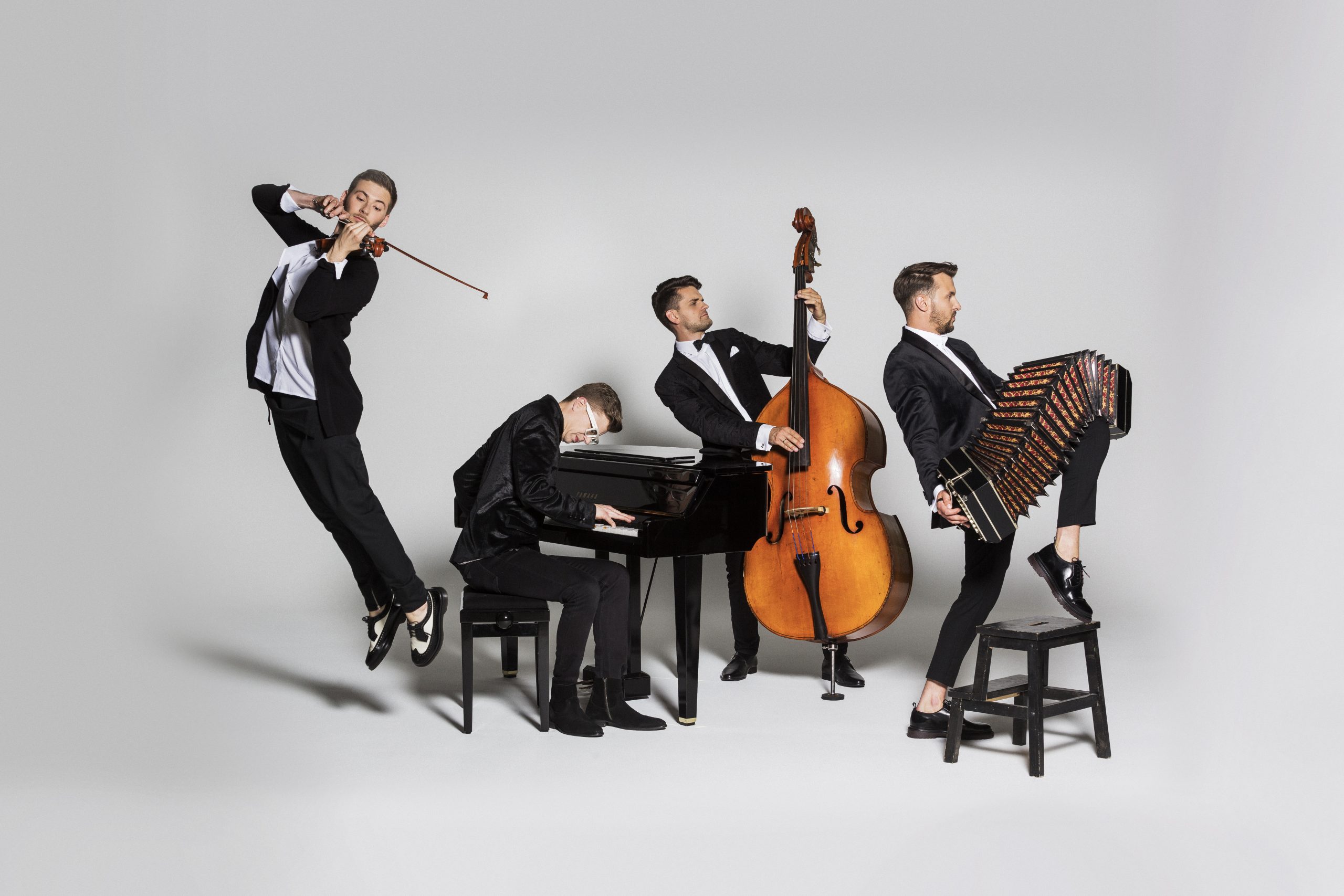

Michał Główka, bandoneon
Jakub Czechowicz, violin
Marek Dolecki, piano
Marcin Antkowiak, double bass
"Tango Meets Jazz"” is a unique project by the Bandonegro ensemble in which tango meets jazz, minimalist music and contemporary improvisation. It is a musical journey in which the ensemble presents an authentic style, combining the pulse of Buenos Aires with a European sensibility.
The concerts feature original compositions by Bandonegro members, as well as fresh and surprising arrangements of Astor Piazzolla's works. The project is the result of years of research and experimentation, resulting in two albums: the critically acclaimed Hello Astor – a dynamic fusion of tango, jazz and rock – and the latest TANUEVO (May 2025), a kind of musical manifesto of a new approach to tango nuevo.
Album TANUEVO was created at the legendary Fortmusic studio in Buenos Aires with the participation of prominent artists, including Daniel “Pipi” Piazzolla (grandson of Astor Piazzolla) and guitarist Lucio Balduini. The album was produced by world-renowned producers, multiple Grammy Award winners. It premiered at the iconic Bebop Club in Buenos Aires.
Astor Piazzolla (1921–1992) was an Argentinian composer, bandoneonist and a key figure in the transformation of traditional tango in the direction of the so-called new tango. Piazzolla developed a new idiom during the 1950s and 1960s that took tango out of its dance function and introduced it into a concert context, drawing on elements of classical music (especially baroque forms), jazz, and contemporary harmony. His work strongly influenced the perception of tango as an autonomous artistic genre.
Libertango (1974) was created during Piazzolla's stay in Europe and symbolizes a liberation from traditional tango forms. The rhythmic repetitiveness and clear formal structure indicate the influences of minimalism and funk.
Adiós Nonino (1959) is one of his most personal compositions, written after the death of the composer's father; it combines a lamentative character with the dramatic contrasts typical of tango nuevo.
Quid it belongs to an earlier period and shows the transition between traditional tango and the later, more complex language.
Concerto for Quintet (1970) is one of the most ambitious works written for his standard quintet (bandoneon, violin, piano, electric guitar and double bass), with clearly developed formal parts and improvisational elements.
Oblivion (1982), originally composed for film music, presents the lyrical, introspective side of Piazzolla's expression, with an emphasis on melody and slow tempo.
Michelangelo '70 it is marked by a strong rhythmic impulse and syncopated structures, reflecting the energy of urban Buenos Aires at the end of the 20th century.
Osvaldo Pugliese (1905–1995) is one of the most important representatives of traditional Argentine tango (classic tango), pianist, composer and orchestra leader. Pugliese developed a distinctive orchestral style based on slower tempos, pronounced dynamics and collective playing. His music strongly influenced both dance and concert tango.
Go to the It belongs to the instrumental tangos, which clearly show Pugliese's preference for tense rhythmic figures and gradual building of form. The piece is often interpreted as a bridge between dance tradition and concert expression.
Marcin Antkowiak (1993), a member of Bandonegro, is a Polish composer and double bassist whose work stems from a dialogue with the tango nueva tradition, but also with contemporary jazz aesthetics. His compositions do not imitate the Argentine idiom, but rather reinterpret it in a European context, with an emphasis on structure, color, and rhythmic flexibility.
Antkowiak is the author of most of the songs on the album. TANUEVO, the latest discographic release of the Bandonegro ensemble, making his compositional style the backbone of the project. His writing develops in close connection with the ensemble's performing line-up and relies on knowledge of the technical and expressive capabilities of each individual member of the quartet. The compositions are shaped as interconnected sections in which instrumental lines organically build on and intertwine, while different styles and influences are integrated within a clearly recognizable tango pulse, which remains the fundamental point of reference.
At tonight's concert, the ensemble performs his compositions Cuyo, Patagonia, Tango power, Tenderness, Gotango i Vislumbrar.
Petra Crnčević
Michał Główka, bandoneon / accordion
Born in 1993 in Poznań, Michał Główka graduated from the Academy of Music in Bydgoszcz in 2018 in the class of Prof. Jerzy Kaszuba. He continued his artistic training with prominent pedagogues and performers, including Prof. Klaudiusz Baran, Prof. Grzegorz Stopa, Prof. Alexander Dmitriev and Jurij Szyszkin. He is a laureate of numerous national and international competitions. A decisive moment in his artistic development occurred in 2010, when he first heard a composition by Astor Piazzolla – an experience that directed his interest in tango and inspired the founding of his own ensemble.
Jakub Czechowicz, violin
Born in 1993 in Poznań, he graduated from the Poznań Academy of Music in 2014 in the class of Prof. Wojciech Maliński and Prof. Michał Grabarczyk. He has won numerous awards at national and international violin competitions, and has further improved his skills at master classes with renowned artists such as Robert Kabara, Kazimierz Kudanowski, Roberto Siri, Klaudiusz Baran and Konstanty Andrzej Kulka. He is the founder and president of the Foundation La Vita Arte, aimed at promoting tango music through research, publishing, artistic and educational projects.
Marek Dolecki, piano
Born in 1993 in Poznań, he studied in the class of Prof. Bogumił Nowicki and graduated from the Academy of Music in Poznań. He is a prizewinner at the international piano competitions "Amadeus" in Brno, "Concours Musical de France" in Kraków and "Hillera" in Görlitz. He perfected his artistic design under the guidance of Aleksej Orłowiecki, Martin Hughes, Robert Siri, Elżbieta Tarnawska, Monika Sikorska-Wojtache and Waldemar Wojtal.
Marcin Antkowiak, double bass
Born in 1993 in Poznań, he is a composer, arranger and instrumentalist. He began his musical education on the piano, and in 2004 switched to the double bass. He graduated with honors from the Academy of Music in the class of Prof. Szymon Guzowski. He collaborates with numerous orchestras and philharmonics in Poland and abroad, and in 2017 he auditioned for the position of double bassist of the Monte Carlo Philharmonic Orchestra. He is a laureate of the 14th "Tadeusz Ochlewski" Composers' Competition organized by the Polish Music Publishing House. At the invitation of the German television ARD in 2020, he composed and arranged music for the film Dance Tango with me.
Astor Piazzolla
Libertango
Adiós Nonino
Quid
Concerto for Quintet
Oblivion
Michelangelo 70
Osvaldo Pugliese
Go to the
Marcin Antkowiak
Cuyo
Patagonia
Tango power
Tenderness
Gotango
Vislumbrar
"A beautiful musical maturity and an exceptionally original sound that faithfully conveys the spirit of Astor Piazzolla's music."
Richard Galliano (French composer and multi-instrumentalist)
"Bandonegro is not just an ensemble – it is a phenomenon on the Polish music scene."
Adam Baruch (Jazz Forum)